REVIEW · LISBON
Lisbon Walking Tour – The Perfect Introduction to the City
Book on Viator →Operated by Hi Lisbon Walking Tours · Bookable on Viator
Lisbon rewards curiosity, and this walk is the fast track. You’ll cover downtown Baixa and Chiado on foot, led by an English-speaking local guide who turns landmarks into stories. It’s priced at $1.25 and works on a tip-based model at the end, so the value is really about what your guide brings to the walk.
Two things I like a lot: you get a clean overview of the city’s core sights in about 2.5 hours, and you’ll hear clear, human-scale explanations of big events like the 1755 Lisbon Earthquake and the Carnation Revolution. You’ll also see major visual anchors in one route: the Santa Justa Elevator area, historic squares, and churches that help explain why Lisbon looks the way it does today.
One possible drawback: the pace can feel intense if your guide speaks quickly. A few guests noted it can be hard to catch every detail, especially if you’re not used to strong accents, so be ready to ask questions in the moment if something matters to you.
In This Review
- Key highlights worth showing up for
- Why this Lisbon walking tour is such a smart first move
- Meeting at Praça do Comércio: the easiest start in Lisbon
- Baixa and Chiado on foot: from squares to the Santa Justa area
- Igreja de S Domingos, Lisbon’s memory, and the earthquake story you can actually use
- Largo do Carmo and the Carnation Revolution: politics in the street
- Rossio, São Roque, and the Lisbon that survived 1755
- Avenida da Liberdade, Casa do Alentejo, and finishing in Bairro Alto
- The guides make or break it: Tiago, Jose, Natalia, Walter, Kate
- Price and tipping: what $1.25 really means for value
- What to expect on the ground: time, comfort, and rain
- Who should book this tour, and who might pass
- Should you book Lisbon Walking Tour – The Perfect Introduction to the City?
- FAQ
- How long is the Lisbon walking tour?
- What language is the tour offered in?
- Where do I meet the guide?
- Where does the tour end?
- How big is the group?
- Are the attractions and stops ticketed?
- Can I cancel and get a refund?
Key highlights worth showing up for
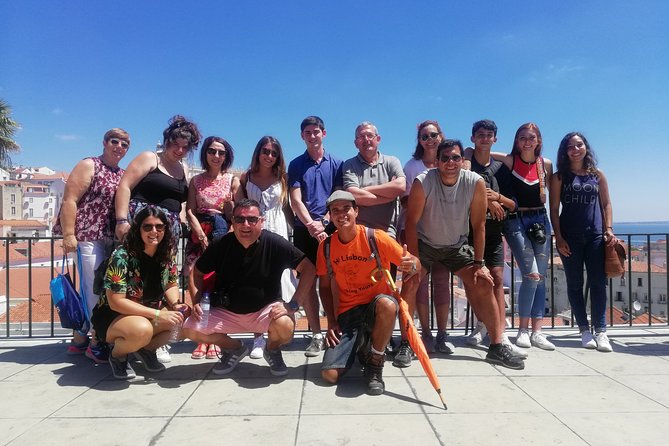
- Praça do Comércio start: meet by the big arch and the statue in the middle, guided by an orange umbrella
- Santa Justa Elevator moment: you’ll stop near one of Lisbon’s best-known landmarks and learn why it’s iconic
- Earthquake survivors: the route includes churches tied to the 1755 earthquake, including one that survived
- 1506 Jewish massacre memorial: a serious historical stop you’d likely miss on your own
- Largo do Carmo: connects Lisbon’s later modern identity to the Carnation Revolution
- Bairro Alto at the end: finish in the nightlife zone so you can keep the evening going
Why this Lisbon walking tour is such a smart first move
I like tours that do two jobs at once: they show you where to walk, and they teach you what you’re seeing. This one is built for exactly that. You’re guided through the densest layers of central Lisbon, so by the time you’re done, you’re not just standing in front of pretty buildings. You understand how Lisbon rearranged itself after 1755, why certain places became symbols, and how later political change played out in the streets.
The route is also friendly in practical terms. The group is capped at 20 people, which usually means less time waiting around at each stop. And it’s in English, so you can actually follow the story rather than guessing from your own pronunciation skills and your best hand gestures.
The other big plus is that it’s not only about famous monuments. You’ll also encounter memorials and churches that add depth. That makes the tour feel like Lisbon, not like a greatest-hits slideshow.
You can also read our reviews of more walking tours in Lisbon



Meeting at Praça do Comércio: the easiest start in Lisbon
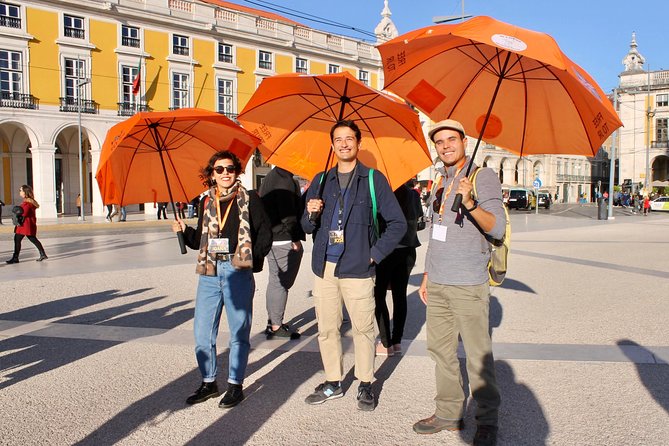
This tour kicks off at Praça do Comércio, Lisbon’s big ceremonial square by the Tagus area. The key detail is finding your guide quickly. You’ll look for an orange umbrella at the square, positioned between the big arch and the central statue.
Why this matters: Praça do Comércio is huge, and Lisbon navigation is much easier once you’ve made that first connection. If you arrive early, take 3 minutes to scan for the umbrella rather than wandering into the side streets and losing time.
As you begin, you’ll start at the statue of D. José I. That’s a nice way to set context because it frames the story of Lisbon as a city with rulers, rebuilding, and public life happening in the open.
From there, you move straight into the heart of the city’s main civic spaces: the tour doesn’t waste your morning.
Baixa and Chiado on foot: from squares to the Santa Justa area
One of the reasons I recommend this walk early is that it acts like a map you can feel in your legs.
You’ll spend time in Praca do Comercio, the biggest square in Lisbon. It’s also where Lisbon’s street energy starts to make sense. Standing there, you can see how the downtown grid pulls people toward major landmarks.
Next you’ll pass Municipal Square, where the city hall is located. Even if you don’t plan to go inside, it helps you understand how governance and everyday life share the same physical space here.
Then comes the stop near Elevador de Santa Justa. This is one of the city’s most famous landmarks, and the point of the stop isn’t just the photo. Your guide explains what made it stand out and why it became such a recognizable piece of Lisbon’s identity. Expect a classic “oh, I’ve seen this before” moment, but with context that makes it more than just a postcard.
You’ll also hit Praca Dom Pedro IV, an older square that anchors the city’s central rhythm. From there, you walk through Rua Augusta, Lisbon’s important street. This is where the tour shifts from monuments to movement: you see the street as a connector, not a background for shopping.
If you want a practical takeaway: after Rua Augusta, you’ll better understand which routes feel like shortcuts and which ones are better for strolling later.
Igreja de S Domingos, Lisbon’s memory, and the earthquake story you can actually use
A good introductory tour should make Lisbon’s major events feel understandable. This is where the story gets serious.
You’ll stop at a memorial for the victims of the Jewish massacre of 1506. It’s the kind of historical marker that adds a human weight to the city. Without a guide, many people walk past these places without realizing the meaning behind them. Here, you get the context so the memorial becomes part of Lisbon’s story, not just a plaque.
Then you’ll visit Igreja De S Domingos, described as one of the most impressive churches in Europe. I like this stop because it shows how Lisbon uses grand architecture to communicate identity and faith. Even if you’re not a “church person,” it’s a good moment to slow down, look closely, and understand why this building commands attention.
From there, the tour moves toward Avenida da Liberdade, Lisbon’s fancy boulevard. It’s a different Lisbon flavor than the tighter downtown streets. Think of it like the city changing gears: from historic core to a more elegant, wide-open avenue feeling.
A quick word on the pacing: if your guide tends to talk fast, this is the part where you may want to lean in and ask a follow-up. The earthquake and the later history stops rely on you catching the key ideas, not just the visuals.
Largo do Carmo and the Carnation Revolution: politics in the street

One of the most interesting parts of the route is that Lisbon isn’t only about old stones. You also get a stop that connects directly to modern political change: Largo do Carmo.
This is tied to the Carnation Revolution, and your guide uses the location to explain what happened and why people remember it. Even without going into museums or official sites, this is a powerful way to understand how a city’s history isn’t locked in the past. It shows up in public spaces.
It’s also tied to the Carmo Church ruins, which connect back to the 1755 earthquake theme. That pairing matters. It helps you connect two time periods: destruction and rebuilding on one hand, and later civic transformation on the other.
In other words, this stop gives you Lisbon’s timeline without turning the walk into a lecture.
You can also read our reviews of more city tours in Lisbon






Rossio, São Roque, and the Lisbon that survived 1755
Your tour includes Estacao Do Rossio, the historic central station area. You’ll get it as a point on the map, not just a building. Stations tell you how Lisbon moves people, and Lisbon’s center becomes easier to navigate once you’ve anchored yourself to Rossio.
After that, you visit Igreja de Sao Roque, one of the churches that survived the Earthquake of 1755. This is a great place to slow down, because the earthquake angle stops being abstract. You’re standing at a location tied to survival, and your guide connects that to the way Lisbon rebuilt and reshaped the city.
Why this is valuable: you’ll leave the walk understanding why certain structures feel like they’re carrying older layers. It’s not just “Lisbon is historic.” It’s Lisbon is layered, and a quake is one of the reasons those layers exist.
Then you’ll move to Praca Luis de Camoes, one of Lisbon’s most iconic squares. This helps you transition from the history-focused section into a more open, scenic feel before the final neighborhoods.
Avenida da Liberdade, Casa do Alentejo, and finishing in Bairro Alto
Along the way, you’ll stop at Casa do Alentejo, described as one of the most charming houses in Lisbon. This is one of those stops that makes the tour feel local. It’s not only about “the big-ticket” monuments. It’s about the character buildings you’d probably walk past without knowing what to look for.
Then the route finishes in Bairro Alto, Lisbon’s famous nightlife area. I like that the walk doesn’t end in some random dead zone. Instead, you close near places where you can keep exploring on your own, grab a drink, and start building your own evening plan with the context your guide just gave you.
It also helps you with timing: once you know the central layout, you can return later without doing mental cartography all day.
The guides make or break it: Tiago, Jose, Natalia, Walter, Kate
What drives the high rating here is the way the guides tell Lisbon’s story. Names that came up in strong reviews include Tiago (also seen as Tiabo), Jose (including Jose Tenorio), Natalia, Walter, and Kate/Clay.
The consistent theme: the best guides don’t just list facts. They connect places to events and explain what you’re looking at. People praised the storytelling style and how it makes the city feel alive, especially with earthquake explanations and the Carnation Revolution angle.
You’ll also hear practical tips from guides. Several guests highlighted that their guides offered advice on good, inexpensive places and even restaurant or viewpoint recommendations. That’s a big deal on a first visit, because it saves you from spending your limited time wandering into tourist traps.
Still, a fair warning from reviews: a few people said certain guides speak quickly and can be hard to follow, and one guest had a sour start about tip expectations. If you’re the type who hates any ambiguity about money, bring cash and decide your tip amount before the tour ends.
Price and tipping: what $1.25 really means for value
At $1.25 per person, this is not priced like a typical “you pay a lot, you get a lot” tour. The value comes from two places:
- a structured route through major central Lisbon stops
- a guide who does the heavy lifting of explaining what you’d otherwise miss
So yes, you should plan to tip. The tour explicitly mentions paying your guide at the end based on what you see fit. That means your guide’s income is strongly tied to how guests value the experience.
One review complaint mentioned an opening remark that set a minimum tip expectation (called out as €10 per person) and left a bad taste for that guest. That’s not something I’d assume is universal, but it’s a useful heads-up: if you prefer a fixed-price tour with no discussion about tipping, you may want to compare options. If you’re comfortable with tip culture, you’ll likely find the price feels like a bargain relative to what you learn.
What to expect on the ground: time, comfort, and rain
The tour runs about 2 hours 30 minutes and covers downtown on foot. You’ll be outside most of the time, and the tour is designed to keep moving rather than stopping for long breaks.
Shoes matter. One guest specifically recommended comfy shoes, and I agree: even in “easy” city walking, squares and slopes can add up over 2.5 hours.
Also, Lisbon weather happens. A review mentioned rain about half the time, and the tour still ran. Bring a rain layer or poncho so you can stay comfortable and actually listen when the wind and drizzle pick up.
Who should book this tour, and who might pass
This tour is ideal if:
- you’re in Lisbon for the first time and want downtown orientation fast
- you want the earthquake and revolution context without reading a book
- you like walking and prefer learning through street-level stops
- you want a small-group experience (max 20) in a single morning block
It may be less ideal if:
- you strongly dislike any tip discussion at the start or during the experience
- you have trouble hearing guides who speak quickly
- you want a long sit-down format instead of walking between landmarks
If you’re flexible and curious, this is exactly the kind of first-day activity that makes the rest of your trip easier.
Should you book Lisbon Walking Tour – The Perfect Introduction to the City?
If you want a smart start, I think you should book it. The route hits the kind of central Lisbon landmarks that help you navigate later: Praça do Comércio, Santa Justa, key squares, churches tied to 1755, and Largo do Carmo for the Carnation Revolution. Add the small group size and English guidance, and you get a lot of city orientation for a very low sticker price.
Just go in prepared. Wear comfortable shoes, bring rain gear, and decide your tipping comfort level ahead of time. If you do that, you’ll leave with a Lisbon map in your head and a better sense of why the city rebuilt, remembered, and changed.
FAQ
How long is the Lisbon walking tour?
It lasts about 2 hours 30 minutes.
What language is the tour offered in?
The tour is offered in English.
Where do I meet the guide?
Meet at Praça do Comércio (1100-148 Lisbon). Look for the guide with an orange umbrella between the big arch and the statue in the middle.
Where does the tour end?
The tour ends around Praça Luís de Camões (Largo Luís de Camões, 1200-243 Lisboa).
How big is the group?
The tour has a maximum of 20 travelers.
Are the attractions and stops ticketed?
The tour includes admission tickets that are listed as free for the stops shown.
Can I cancel and get a refund?
Yes. You can cancel for free up to 24 hours in advance for a full refund. If you cancel less than 24 hours before the start, the amount paid is not refunded.