REVIEW · LISBON
Food & Wine Lisbon Tour with Local Guide in Private Eco Tuk Tuk
Book on Viator →Operated by Eco Tuk Tuk - Portugal · Bookable on Viator
Lisbon glides by electric tuk-tuk, no stress. This private 3-hour ride connects big Lisbon sights—riverfront to hilltop viewpoints—while your guide keeps everything moving on tight, twisty streets. You’ll travel in a 100% electric eco tuk-tuk, so the experience feels easy from the first minutes.
I especially like the quick, queue-free start and the fact that your guide can adapt the tastings for vegetarian diets. You’re not just sightseeing; you get snacks with wine, cheeses, and other local favorites as you move through the city.
One possible drawback: the food is more tasting-sized than a full meal, and the exact selection can vary. If you were hoping for a very specific, heavy-food menu, you might find the emphasis is still mainly on Lisbon’s places first, then tastings.
In This Review
- Key things to know before you go
- Why the private eco tuk-tuk feels like the smart way to see Lisbon
- Price and value in plain numbers: what you’re really paying for
- Meeting at Lisbon Cruise Port and staying out of trouble
- Cais do Sodré: the river district where Lisbon eats and listens
- Chiado: elegant cafés, classic bookstores, and easy city context
- Bairro Alto: cobblestones, fado venues, and nighttime energy (even by day)
- Baixa and Praça do Comércio: where Lisbon’s 1755 rebuild still shows
- Sé de Lisboa and Portas do Sol: old church lines and a sunrise-minded viewpoint
- Miradouro Nossa Senhora do Monte: the viewpoint with a chapel story behind it
- Graça, São Vicente de Fora, and the National Pantheon: Lisbon’s layers, up close
- Chafariz de El-Rei: Lisbon’s public water system and a surprising social twist
- Food and wine tastings: what’s included, and how to set expectations
- Comfort, photo stops, and what makes the guide matter
- Should you book? The best fit for this Lisbon food and wine eco tuk-tuk
- FAQ
- What’s included in the Lisbon food and wine eco tuk-tuk tour?
- Is this tour private or shared with other people?
- Can the menu be adapted for vegetarians?
- Where does the tour start, and do you offer hotel pickup?
- Are there any age or weight limits?
- Can I cancel and get a full refund?
Key things to know before you go
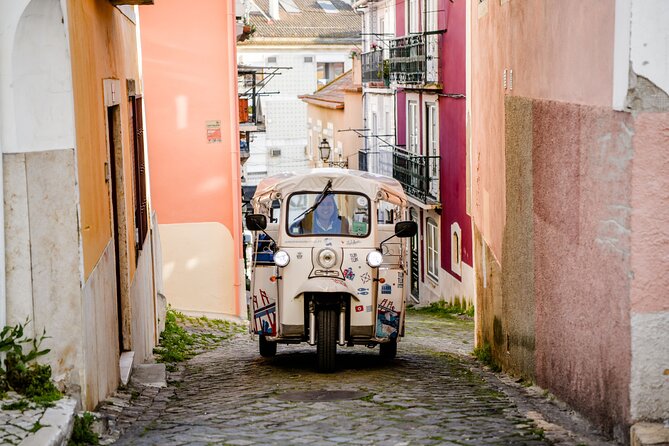
- Private eco tuk-tuk with only your group: no waiting around for other parties.
- Queue-free start: you get moving without the usual lines.
- Tastings included, with vegetarian options: wine, cheeses, and other small samples.
- Rain-and-wind protection built in: blankets and covers keep you comfortable.
- Pre-selected photo stops: you’ll hit the viewpoints you actually want, without scrambling.
Why the private eco tuk-tuk feels like the smart way to see Lisbon
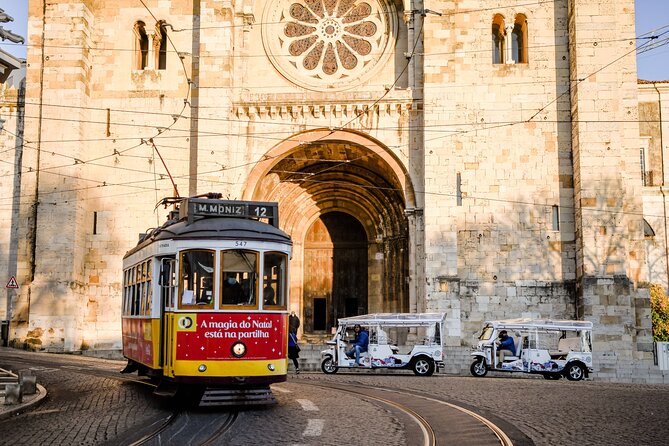
Lisbon has hills, cobblestones, and streets that don’t care about your walking pace. I like that this tour solves the problem with an electric eco tuk-tuk that’s made for navigating narrow lanes and turning quickly where a normal vehicle would struggle.
Because it’s private, you’re not stuck in a slow-moving group. You can go at a comfortable speed, pause when you want a view, and get to the next stop without the chaos that comes from crowds peeling off in ten directions.
Also, the ride is designed for real comfort. You’ll get blankets and protective covers for rain and wind, which matters in Lisbon where the weather can change faster than your phone battery.
You can also read our reviews of more food & drink experiences in Lisbon



Price and value in plain numbers: what you’re really paying for
At $107.03 per person for about 3 hours, this isn’t a budget street-food sprint. You’re paying for a private guide, a private vehicle, and included tastings—plus time saved by starting without queues.
You also get itinerary efficiency. Instead of spending your day crossing town and guessing routes, you’re guided through major districts and viewpoints in a loop that hits a lot of must-see landmarks. If you’re on a short trip (or doing Lisbon from a cruise), the time value is often the biggest reason this style of tour makes sense.
If food is your main priority, here’s the honest angle: the included tastings are real, but they’re not a full dining experience. You’ll taste, not feast.
Meeting at Lisbon Cruise Port and staying out of trouble
The tour starts at the Lisbon Cruise Port – Jardim do Tabaco Quay (near the main terminal building exit). You’ll want to be right at that chosen pickup spot and not wander to a different entrance, because the instructions are strict.
If you’re booking the 3- or 4-hour option, you may have a choice of pickup location for cruise guests (you’ll be prompted to choose the day before between Time Out Market or the cruise port). The key is to follow the exact instructions so you don’t lose time.
One scheduling note that’s worth your attention: if you’re late, the tour may get shortened, and if the delay is more than 15 minutes it can be cancelled without a refund. That’s not meant to be harsh—it’s how private tours protect everyone’s time.
Cais do Sodré: the river district where Lisbon eats and listens

Cais do Sodré is a riverside area known for nightlife and restaurant energy. From the tuk-tuk, you’ll get an easy view of the contrast: busy streets nearby, then the river air that makes everything feel more open.
A highlight here is the 19th-century Ribeira Market, especially the food-court style area where you can graze on eclectic stalls. This is a great place for your “wait, this city loves food” moment because you’re surrounded by a mix of international dishes and Portuguese staples.
You’ll also pass by places tied to Lisbon’s famed fado scene—Pink Street is known for bars and restaurants where the music takes center stage. Even if you don’t go inside for a performance, it helps you understand how food, drink, and music sit in the same cultural package in Lisbon.
Chiado: elegant cafés, classic bookstores, and easy city context
Next comes Chiado, a central district with a strong cultural scene and an old-but-polished vibe. I like the way the tour positions Chiado between Baixa and Bairro Alto, because it helps you understand Lisbon’s layout like a map, not just a list of stops.
This area is home to famous anchors like Café A Brasileira, the historic Livraria Bertrand (the world’s oldest operating bookstore), and the São Carlos Theater. Seeing these landmarks close up gives you better context for Lisbon’s arts and intellectual side than most quick photo stops.
Practical tip: Chiado is also one of those neighborhoods where you’ll want a short wander after the tour. The streets are laid out so well that you can follow your guide’s cues and keep exploring on your own.
A few more Lisbon tours and experiences worth a look



Bairro Alto: cobblestones, fado venues, and nighttime energy (even by day)

Bairro Alto sits high on one of Lisbon’s hills, and it’s famous for its maze of narrow, cobblestone streets. It’s the kind of area where the vibe shifts with the hour—by day it feels more relaxed, then in the evening it turns into one of the city’s main nightlife zones.
The tour connects you to why the neighborhood matters culturally: you’ll see the density of late-night cafes and the presence of fado music venues. Even if you’re not there for a full night out, you’ll get a sense of Lisbon’s rhythm and how locals socialize after dinner.
A small caution for planning your day: Bairro Alto’s lanes are tight, and those hills mean you’ll appreciate the tuk-tuk ride versus walking long distances. This is one of the stops where the vehicle choice really pays off.
Baixa and Praça do Comércio: where Lisbon’s 1755 rebuild still shows
Baixa is the commercial and architectural core of Lisbon, rebuilt after the devastating 1755 earthquake. I like this stop because it gives you an urban story you can actually see: wide boulevards, neoclassical buildings, and a street grid that still makes the city easier to navigate.
From there you roll into Praça do Comércio, Lisbon’s huge riverside square next to the Tagus River. It’s enormous—about 36,000 m²—with 79 arches along the border. This is the kind of space that makes photos work even when you’re just standing there for a minute, because the river and skyline frame you.
This is also a power-and-history type of place. The square is tied to the Portuguese kings’ palace area and the idea of political power and state centralism. You don’t need a lecture to feel it; the scale does the talking.
Sé de Lisboa and Portas do Sol: old church lines and a sunrise-minded viewpoint
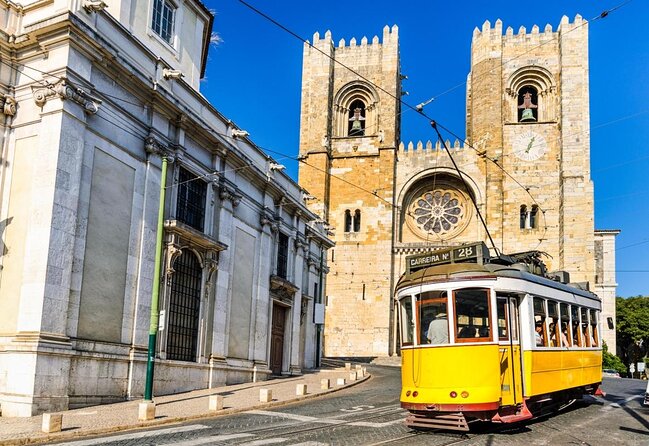
Next you visit Sé de Lisboa, also called the Lisbon cathedral. Construction began in 1148, and it’s regarded as the oldest church in Lisbon. When you see it in person, it anchors the whole tour: you’re no longer only moving through districts—you’re standing in a place that survived centuries.
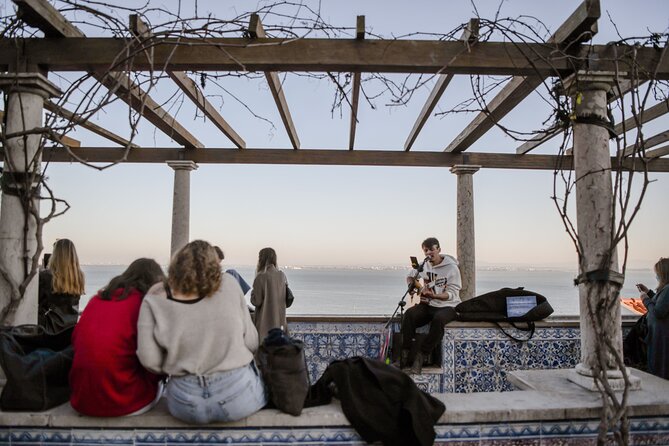
Then you head toward Largo das Portas do Sol in Alfama, one of Lisbon’s iconic viewpoint squares. You’ll get the kind of panoramic view that makes you understand why Lisbon attracts artists and photographers: the Tagus River, the Baixa Pombalina grid, and the nearby Castelo de São Jorge.
What I find neat is the name: Portas do Sol connects to a historic city gate facing east, built to let sunlight in during morning hours. It’s a clever reminder that Lisbon’s best views were shaped by how people planned daily life centuries ago.
Miradouro Nossa Senhora do Monte: the viewpoint with a chapel story behind it
One of the tour highlights is Miradouro Nossa Senhora do Monte in Graça. This viewpoint is famous for sweeping panoramas over Lisbon and the Tagus River, and the tour adds context through the Chapel of Nossa Senhora do Monte.
The chapel area links to the long timeline of Lisbon’s reconquest after Moorish rule, with roots in the 12th century. Over time, it became a pilgrimage spot for blessings and protection, with renovations after the 1755 earthquake.
This is a good moment to slow down. The scenery does the work, and the extra history turns a pretty view into something you remember longer.
Graça, São Vicente de Fora, and the National Pantheon: Lisbon’s layers, up close
You’ll also pass through Graça, a traditional neighborhood known for narrow cobbled streets and lots of viewpoints (miradouros). What’s appealing here is that it feels more like daily life than a theme park, while still being well-connected to the rest of your route.
From there, you visit the Monastery of São Vicente de Fora. The name “de fora” matters: it refers to the monastery being outside the old city walls, at a time when it wasn’t under the Lisbon bishop’s jurisdiction.
Then comes the National Pantheon of Portugal (Panteão Nacional), located in the Church of Santa Engrácia. The current building stands on earlier church foundations established in 1568, and it became a pantheon in 1916. It’s a powerful pairing with the viewpoint stops, because you’re seeing both landscape and monuments.
Even without going deep into details, this stretch helps you understand why Lisbon keeps stacking old structures on high ground. You get the city’s “layers” feeling in a single ride.
Chafariz de El-Rei: Lisbon’s public water system and a surprising social twist
The tour includes Chafariz de El-Rei, the first public ornamental fountain in Lisbon. It dates to the 13th century, built during the reigns of Afonso III and Denis I, using excellent groundwater from the Alfama area.
Here’s the fun part: this wasn’t just decoration. Water channeling to outdoor gutters traced back to 1487, which helped supply ships during the Age of Discovery. That means this fountain sits right in the middle of Lisbon’s global expansion story.
The façade you see today dates from 1864. And in earlier times, the fountain had nine functioning gutters, each reserved for a specific social group. It’s one of those small stops that changes how you see everyday city infrastructure—because it was part of social structure, not just water.
Food and wine tastings: what’s included, and how to set expectations
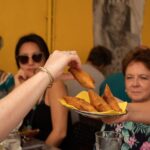
The tour includes snacks and different tastings of wine and cheeses. There’s also an option to adapt the menu for vegetarians, which is great if you worry about being left out.
One important takeaway for your expectations: tastings can be flavorful and varied, but the exact lineup may differ from what you picture. In one example, the actual focus leaned heavily into tastings like multiple olive oils, bread, cheeses, and even a sliced cooked sausage made from Iberian pork, paired with white and red wine plus a port sample.
So if you want Portuguese classics like a specific sandwich or a particular pastry, don’t assume it will be the exact menu item you envisioned. Think of the tastings as guided sampling rather than a guaranteed set list of dishes.
If food is your angle, still go for it—you’ll learn how Lisbon tastes through multiple small bites. Just come with the mindset to enjoy variety, not to hunt down one exact signature dish.
Comfort, photo stops, and what makes the guide matter
A big part of why people love this tour is the guide. You’ll likely get a strong connection between what you see and what you taste, plus helpful context so the city doesn’t feel like random landmarks.
Two guide names come up often: Arthur and Thiago. If you have the chance to request a guide, Arthur is noted for making the tour feel special, and Thiago is described as enthusiastic and strong on history.
Logistically, you’re not asked to constantly work your phone camera angles. The tour includes pre-selected stops for photographs, so you’re not searching for the best viewpoint while hungry and cold.
And since it’s a tuk-tuk, the route includes a lot of “look here” moments rather than hours of walking. That’s a big win if you want comfort and city coverage.
Should you book? The best fit for this Lisbon food and wine eco tuk-tuk
Book this tour if you want private, fast Lisbon highlights with a local guide, and you like the idea of learning the city through neighborhoods, monuments, viewpoints, and tastings. It’s also a smart choice if you’re coming from a cruise and want to pack a lot into a short window.
Skip it (or adjust expectations) if you’re a strict “I want one specific dish” foodie. The food is tastings, not a full meal, and the exact selection can vary. Also, hotel pickup isn’t included, so plan around the set meeting point.
If you value comfort—especially with blankets for wind or rain—and you like guided city context more than self-guided wandering, this is one of the more practical ways to experience Lisbon in a single afternoon.
FAQ
What’s included in the Lisbon food and wine eco tuk-tuk tour?
You’ll get snacks and different tastings of wine and cheeses, along with an expert local driver/guide. The tour also includes a private ride in a 100% electric vehicle, plus blankets and protective covers for rain and wind.
Is this tour private or shared with other people?
It’s private. Only your group participates, and the tuk-tuks are booked based on your group size (up to 4 passengers per tuk-tuk).
Can the menu be adapted for vegetarians?
Yes. The menu can be adapted for vegetarians.
Where does the tour start, and do you offer hotel pickup?
The tour starts at the Lisbon Cruise Port – Jardim do Tabaco Quay, and it ends back at the meeting point. Pick-up at hotels is not included.
Are there any age or weight limits?
Yes. The minimum age is two years old (no babies allowed), and there’s a minimum mandatory weight of 9 kg.
Can I cancel and get a full refund?
Yes. Cancellation is free up to 24 hours before the experience starts for a full refund. If you cancel less than 24 hours before, the amount paid will not be refunded.