REVIEW · PORTO
Porto: Historical Center Walking Tour
Book on GetYourGuide →Operated by Footstepers · Bookable on GetYourGuide
Porto’s history is close enough to touch. This Historical Center walking tour starts at the Sé Cathedral area and strings together Porto’s big religious landmarks, river-world views, and hillside streets in a smart loop you can’t easily piece together on your own. I especially like the way it pairs the jaw-dropping cathedral complex with the river-side Ribeira neighborhood, and I love how the guide, often Lucas, keeps things lively and adaptable, including real local tips like where to sample port from smaller producers.
The main thing to think about: this is a real walking tour with stairways and uneven surfaces, so it’s not a good fit for people with mobility impairments.
In This Review
- Key highlights I’d prioritize
- Starting at the Vimara Peres statue: your map in real life
- Sé Cathedral to Ribeira: religion meets the river trade
- Palácio da Bolsa, Vitória, and the XIV-century defensive-wall loop
- Clérigos Church and the climb toward Juderia do Olival
- Livraria Lello, Avenida dos Aliados, and why the streets feel staged
- São Bento Station and Paço Episcopal: stonework with real authority
- Córdobaia monuments and the “whole layout” payoff
- Guide quality: Lucas’s adaptability is the real secret
- Pace, comfort, and who should take this
- Is this tour worth booking for $32?
- Should you book this Porto Historical Center walking tour?
- FAQ
- Where does the tour start?
- How long is the Porto Historical Center walking tour?
- How much does it cost?
- What’s included in the price?
- What languages are available?
- Which stops are included on the route?
- Is there a cancellation option if plans change?
- Can I reserve without paying right away?
- What should I wear or bring?
- Is the tour suitable for people with mobility impairments?
Key highlights I’d prioritize
- Sé Cathedral start right by the Vimara Peres statue, so you get your bearings fast
- Ribeira + river port energy where traders and tides shaped the city
- Palácio da Bolsa and Vitória viewpoints to see how power and money sit in the streets
- Juderia do Olival area reached by that “why does this street keep climbing?” feeling
- São Bento Station and Paço Episcopal for stonework and institutional Porto in one go
Starting at the Vimara Peres statue: your map in real life
The tour begins at the Estátua de Vímara Peres near the Sé Cathedral. That matters more than it sounds. If you start in the right spot, Porto’s maze of streets stops feeling random and starts feeling like a plan.
From here, you’re in the old-core zone where religious influence isn’t an abstract concept. It’s built into the street level: churches, walls, official buildings, and the way people historically gathered and moved through the center. Expect a short introduction at the beginning, then the walk becomes your “moving orientation.”
You can also read our reviews of more walking tours in Porto


Sé Cathedral to Ribeira: religion meets the river trade
One of the tour’s best moves is the early contrast: grand religious architecture first, then the working river neighborhood right after.
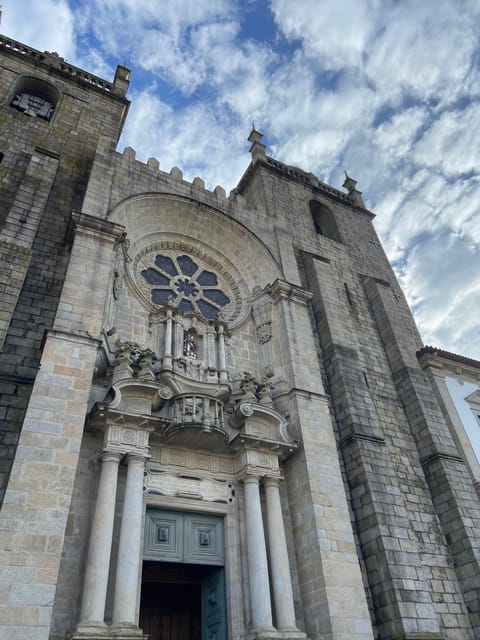
At the Porto Cathedral area, you’ll get context on how faith and civic life intertwined as Portugal formed and matured. It’s not just facts about dates. It’s about why the city grew the way it did—especially once Porto became a true port city.
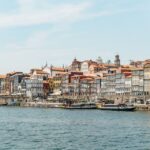
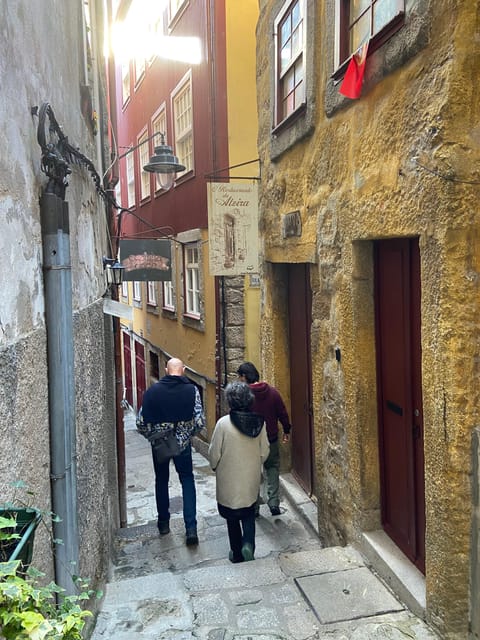
Then the walk drops toward Ribeira, the traders’ riverside side of town. This is where you see how Porto’s identity is tied to the Douro River and commerce. Even if you think you already know Porto from photos, the scale of the riverfront streets hits differently on foot. You get narrow alleys, turning corners, and sudden glimpses of the water—exactly the kind of street-level sequencing that a guided loop does well.
Palácio da Bolsa, Vitória, and the XIV-century defensive-wall loop
After Ribeira, you’ll head toward the Cordoaria area and key monuments that help explain Porto’s shape. A big theme here is protection and authority: not just where pretty buildings are, but why they ended up where they did.
The Palácio da Bolsa stop is a highlight because it’s tied to the commercial side of Porto’s story. You’re looking at architecture that reflects a city built to trade, negotiate, and profit—then you keep moving so it doesn’t feel like a standalone museum visit.
From there, the tour leans into the Vitória district and viewpoints that make the hills make sense. Porto is not flat; it’s layered. Walking is the only way to understand that layering. When you’re on streets that climb and then level out, it becomes obvious how routes evolved around defense and access.
A key route element is following the line of the XIV-century defensive wall to loop around the historical center. The wall itself is part of the “why.” Even when you’re looking at churches or major landmarks, you’re also reading the city’s defensive logic: where movement needed to be controlled, and where residents could expand.
Along this general loop, you’ll also pass through major landmarks such as St. Francis Church, the Palace of Justice, and major sights tied to the center’s most famous streets and institutions. The tour keeps the stops timed well so you’re not stuck listening forever and you’re not sprinting either.
Clérigos Church and the climb toward Juderia do Olival
If Porto has one signature “vertical moment,” it’s the area around Clérigos Church (and the nearby tower views that people come for). The tour uses this section to give you a sense of how the city’s skyline and its street rhythms connect.
This is also where the walk starts to feel more like an adventure. You’ll tackle stairways and changes in elevation, and the guide’s pacing becomes important. You’ll want comfortable shoes, and you’ll want to accept that Porto’s old center is old in the literal sense—uneven stone and steps are part of the experience.
Then comes the walk up to Juderia do Olival, the Jewish Quarter area. You won’t just get a vague label; you’ll connect it to how different communities and religious traditions shaped Porto. The value here is that you’re walking through time, not just stopping at one postcard viewpoint.
Livraria Lello, Avenida dos Aliados, and why the streets feel staged
Next up is Livraria Lello & Irmão, the famous bookshop that’s become a cultural magnet. Even if you’re not a book-lover, this stop works because the guide ties it into why Porto developed its identity as a city of ideas and learning.
Right after that, you’ll move through Avenida dos Aliados, which is the city’s grand, formal street energy. This stretch is useful because it gives you a different Porto rhythm than the tiny alleys. You’ll see how the historical center meets the more “public square” side of city life.
This combination—famous shop intensity, then a wide boulevard—helps you understand Porto as more than a single neighborhood. It’s a patchwork of styles, periods, and purposes, and walking ties those pieces together better than hopping by taxi.
You can also read our reviews of more historical tours in Porto



São Bento Station and Paço Episcopal: stonework with real authority
One of the most practical parts of the tour is the São Bento Station stop. It’s not just a pretty building moment. It’s a big “you are in Porto now” landmark, and it’s a natural pause mid-walk.
You’ll spend about 30 minutes there, which feels like the right amount of time to absorb what you’re seeing without turning it into a long detour. It’s also a nice chance to reset—your feet get a breather, and your brain gets a new visual anchor.
Then you’ll head to Paço Episcopal. This is where the tour underlines the religious and institutional side of Porto again. The whole arc of the day returns to the question of influence: who held power, how that power showed up in buildings, and how the city’s character formed around those centers.
Córdobaia monuments and the “whole layout” payoff
The tour’s promise is to help you understand the full layout of the historical center. That’s not marketing fluff here. The route is built so you’re not randomly bouncing from one famous spot to another.
Instead, you get a loop-like feel: cathedral zone, river zone, trade/power monuments, hillside viewpoints, a historic quarter area, and then station + episcopal buildings. By the end, the streets start to connect in your head. You stop thinking in terms of individual stops and start thinking in terms of routes: where you are, where you came from, and what direction you should walk next.
This is where the best guided tours earn their value. At $32 per person for about 2.5 hours, you’re paying for a human guide who can stitch the sights into a coherent story and keep you moving at a steady pace. If you tried to do all of this yourself, you’d likely spend time figuring out routes, then lose the payoff of knowing what you’re looking at.
Guide quality: Lucas’s adaptability is the real secret
In the reviews, Lucas shows up again and again as the kind of guide who makes the tour feel personal. People talk about him being entertaining, passionate about Porto’s past, and able to adjust based on interests. That adaptability matters because Porto can satisfy different tastes: architecture, religion, Jewish quarter context, city walls, or just the simple joy of getting from place to place without getting lost.
One specific example that stands out: Lucas gives practical port wine recommendations, including suggestions for smaller producers. That’s exactly the kind of “after the tour” help that turns a walking route into a better trip.
There’s also a minor consideration: the meeting area is next to the Vimara Peres statue near the Sé Cathedral, and a couple of people noted it can be tricky to spot the guide if there isn’t an obvious sign. My advice: arrive a few minutes early and look for the group cluster rather than waiting at a single point.
Pace, comfort, and who should take this
This is a walking tour, so the big requirement is simple: plan for steps and uneven ground. The tour includes stairways and hillside sections, especially as you move toward Juderia do Olival and the Clérigos area.
It’s also a good match if you like:
- Short guided stops with context (most are around 15 minutes, with a longer São Bento pause)
- A route that prioritizes the historical center layout over a single museum visit
- City history explained in plain language while you’re actually walking it
It’s not a good match if:
- You use a mobility aid or need step-free routes
- You hate uneven stone streets and climbs
The group experience is described as steady-paced and accommodating. You’ll still want to bring your own common sense: water if you run hot, and keep your phone charged for photos because this is one of those Porto days where you’ll want to remember details.
Is this tour worth booking for $32?
At $32 per person for roughly 2.5 hours, this sits in the “smart first day” category. You’re paying for:
- A guided walk that strings together major monuments and neighborhoods
- A local guide who can explain what you’re seeing on the spot
- Help understanding Porto’s geography, not just collecting photos
If your goal is to get your bearings and build a mental map of the UNESCO historical center, the price feels reasonable. If your goal is only to see one or two headline attractions, you might choose cheaper options. But if you want a structured walk that covers Cathedral, river Ribeira, Bolsa, Clérigos, Lello, São Bento, and Paço Episcopal in one loop, this is good value.
Should you book this Porto Historical Center walking tour?
Book it if this is your first or second time in Porto and you want a guided route that helps you connect the dots. It’s especially worth it for the layout learning—you finish with a better sense of how the old city works and where to go next on your own.
Skip it if mobility is an issue or if you prefer slow, independent exploration with no stair-and-stone realities. Porto rewards walking, but it doesn’t do you any favors if you’re expecting flat sidewalks.
FAQ
Where does the tour start?
It meets next to the Estátua de Vímara Peres near the Sé Cathedral of Porto.
How long is the Porto Historical Center walking tour?
The duration is about 2.5 hours.
How much does it cost?
The price is $32 per person.
What’s included in the price?
You get a walking tour and a local live tour guide.
What languages are available?
The live guide is available in English and Spanish.
Which stops are included on the route?
The tour includes stops such as Porto Cathedral, Ribeira, Palácio da Bolsa, Clérigos Church, Livraria Lello & Irmão, Avenida dos Aliados, São Bento Station, and Paço Episcopal, returning to the starting point.
Is there a cancellation option if plans change?
Yes. You can cancel up to 24 hours in advance for a full refund.
Can I reserve without paying right away?
Yes. The option is Reserve now & pay later.
What should I wear or bring?
Bring comfortable shoes and comfortable clothes.
Is the tour suitable for people with mobility impairments?
No, it is not suitable for people with mobility impairments.