REVIEW · LISBON
Lisbon Private Tuk Tuk Tour: City Highlights
Book on Viator →Operated by Battuta Experiences · Bookable on Viator
Lisbon by tuk-tuk is a fast way to get oriented. This private 100% electric tuk-tuk tour strings together the big sights—squares, churches, and major viewpoints—without the hassle of hopping between taxis. You’ll also get a proper driver/local guide, plus an option for hotel pickup in the city center on request.
I especially like that the route focuses on “see it now” spots: Miradouros for panoramic views and classic neighborhoods like Alfama. One heads-up: Lisbon has cobbles and hills, so the ride can feel bumpy at times, and museum/attraction entry fees aren’t included.
In This Review
- Key points that matter before you go
- Electric Tuk-Tuk Lisbon: a 2-4 Hour Orientation Plan
- Restauradores and Rossio: Your First Hits of Portuguese Pride
- Lisbon’s Oldest Church, Santa Engrácia, and the Fado Museum
- Miradouros That Do the Heavy Lifting: Portas do Sol and Senhora do Monte
- Alfama on a Tuk-Tuk: ginjinha, Feira da Ladra, and local street texture
- Praça do Comércio, Rua Augusta Arch, and the “1755” story you can feel
- Praça Luís de Camões to Largo do Carmo: Portuguese pavement and earthquake ruins
- Bairro Alto and Chiado: the bohemian side you can actually spot
- Garden viewpoints: São Pedro de Alcântara and Príncipe Real
- Basílica da Estrela: a neoclassical finish with royal roots
- Price and value: what $83.27 per person really buys
- Small practical tips so your tour feels smooth
- Should you book this Lisbon Tuk-Tuk Highlights tour?
- FAQ
- How long is the Lisbon Private Tuk Tuk City Highlights tour?
- What does the tour cost?
- Is hotel pickup included?
- Is this tour private?
- Is the tuk-tuk electric?
- What language is the tour offered in?
- Are museum or attraction entrance fees included?
- Do I need good weather?
- Can I cancel for a full refund?
Key points that matter before you go
- Private with your group: only your party rides along, so the pace can match your interests.
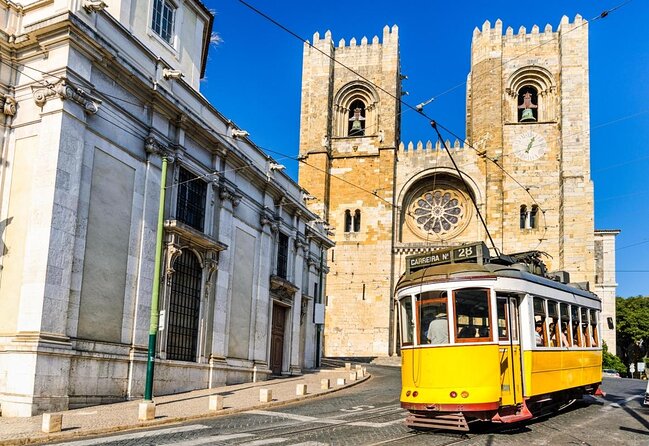
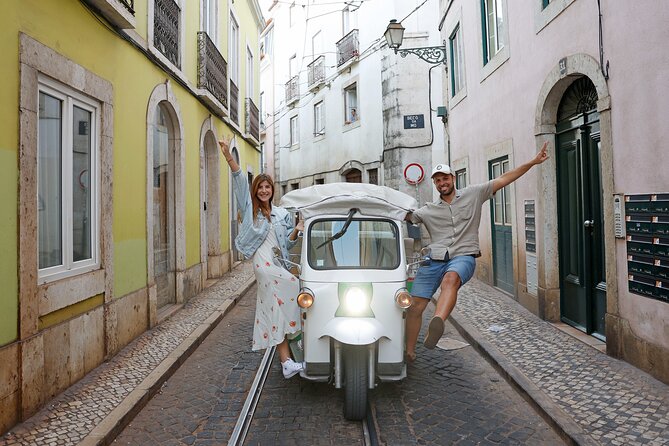
- Electric tuk-tuk ease: quieter and smoother than you’d expect, and great for short stops and photo breaks.
- Viewpoints are built in: Portas do Sol and Senhora do Monte are free and do a lot of the heavy lifting for photos.
- Alfama + fado culture: you’ll pass through the oldest, most typical Lisbon streets and learn about fado and Portuguese guitar.
- Historic squares in a logical arc: you move from central monuments to riverside grandeur and then toward Chiado/Bairro Alto.
- Some days change the vibe: Feira da Ladra runs on Tuesday and Saturday, so plan around the day you’re in town.
Electric Tuk-Tuk Lisbon: a 2-4 Hour Orientation Plan
If you only have a day or two in Lisbon, this is the kind of tour that helps you stop guessing. You get a clear sense of how neighborhoods relate—where Alfama sits, how Bairro Alto rises, and why viewpoints matter—without spending your whole time stuck in transit.
The format is simple: a private tuk-tuk ride lasting about 2 to 4 hours, with frequent stops. It’s offered in English, and you’ll typically find it easy to coordinate because it includes a mobile ticket and you’re near public transportation.
Value-wise, $83.27 per person isn’t a bargain price, but you’re paying for a local guide plus an efficient private vehicle. And you’re not just “being driven.” The stops are placed where you’ll actually want to get out, look around, and take photos—especially at the viewpoints.
You can also read our reviews of more city tours in Lisbon



Restauradores and Rossio: Your First Hits of Portuguese Pride

Your route starts with Monument to the Restauradores. It’s a tall 30-meter obelisk inaugurated on April 28, 1886, marking Portugal’s liberation from Spanish rule on December 1, 1640. Even if the dates mean less to you than the view does, this is a strong first clue about Lisbon’s identity: proud, political, and never far from history.
Next up is Praça de D. Pedro IV, better known as Rossio. This isn’t a random square. It’s been a meeting point for locals for centuries, so it feels like a real social hub—not just a photo backdrop.
This early pairing works well because it sets context fast. After these stops, you’ll start noticing the city’s pattern: grand public spaces, then churches and viewpoints that explain the hills, then neighborhoods that feel lived-in.
Lisbon’s Oldest Church, Santa Engrácia, and the Fado Museum

Soon you’ll be at the oldest church in Lisbon—seat of the Patriarchate—and it’s the kind of stop that makes Lisbon feel layered. This is one of those places where you can look up, slow down, and realize the city has been shaping itself for centuries.
From there, you reach the National Pantheon, installed in the Church of Santa Engrácia. The location alone makes it worth a stop, and it’s an important part of Lisbon’s story—religious significance mixed with national memory.
Then comes the Fado Museum, dedicated to the world of fado and the Portuguese guitar. The practical payoff here is that you’ll leave understanding what you’re hearing later. When you eventually catch fado in a tavern, you’ll have more than just the sound—you’ll know what it’s tied to culturally.
If you plan on going inside any museums/chapels, note that entrance fees for museums aren’t included, so budget a bit extra.
Miradouros That Do the Heavy Lifting: Portas do Sol and Senhora do Monte
If Lisbon had a secret, it would be these viewpoints. Two of the best are scheduled with free admission and enough time to actually take in the view instead of rushing.
At Miradouro das Portas do Sol, you look over the eastern part of the city—classic red rooftops of Alfama and the Tagus River stretching out nearby. This is the spot for “wow, that’s Lisbon” photos, especially around late afternoon when the light gets kinder.
Then you’ll hit Miradouro da Senhora do Monte, often considered one of the city’s strongest panoramas. From here, you can pick out Lisbon’s major features: the Castle of São Jorge area, downtown Lisbon, the Tagus River estuary, Bairro Alto, and even the Monsanto Forest Park.
Use these stops well. Bring water if you get thirsty easily, but keep your bags light so you can move fast for photos. Also, wear shoes with grip. Even when the viewpoints aren’t long walks, the surfaces can be uneven.
Alfama on a Tuk-Tuk: ginjinha, Feira da Ladra, and local street texture

Alfama is the oldest and one of the most typical Lisbon neighborhoods, and the tour treats it respectfully: you get time to slow down and feel the neighborhood rather than just driving past it. It’s the kind of place where the streets don’t care about your timeline.
You’ll also do a fun, practical food-and-drink moment: try ginjinha. This is Lisbon’s cherry liqueur culture in a cup. It’s easy to sample without it turning into a full-on meal, and it makes the Alfama stop feel like something you experienced, not just something you saw.
Depending on the day, you may also pass the Feira da Ladra flea market, which runs every Tuesday and Saturday. If your visit lines up, it adds texture—locals browsing, sellers calling out, and the market vibe that makes Lisbon feel like a living city.
The main consideration: Alfama streets can be narrow and busy. That’s exactly why a tuk-tuk helps. You can reach close-by viewpoints and key corners without doing the full uphill slog.
You can also read our reviews of more private tours in Lisbon






Praça do Comércio, Rua Augusta Arch, and the “1755” story you can feel

Then the tour turns toward the riverside heart: Praça do Comércio. This stunning square once housed a royal palace that was lost in the 1755 earthquake, and now it feels grand and open. It’s the opposite mood from Alfama’s tight streets.
Make sure you connect it to the big theme of Lisbon’s resilience. That 1755 quake is part of the city’s identity, and you’ll keep seeing its echo in architecture and ruins.
Nearby is the Rua Augusta Arch, a classic framing device for Lisbon photos. Even if you’ve already seen pictures, seeing it in the real geometry helps. Your brain finally understands how the city’s central corridor was rebuilt.
If you like to walk, this is a good area to extend your day after the tour. You’ll understand where you are and where to head next.
Praça Luís de Camões to Largo do Carmo: Portuguese pavement and earthquake ruins
Next you’ll visit Praça Luís de Camões, known for its pleasant open space and Portuguese pavement with geometric designs. The motifs reference the sea—mermaids and caravels—and the square also pays tribute to writer Luís de Camões. It’s art on the ground, and it’s the kind of detail you’d miss if you only moved through Lisbon quickly.
After that, the route heads to Largo do Carmo, in the Chiado area. Here you’ll see the ruins of the Carmo Convent, built in the 14th century and destroyed by the 1755 earthquake. This stop is powerful because it’s not a dramatic reenactment. It’s simply what’s left—and it forces you to notice history in the open air.
It’s a good break from pure sightseeing. Even a quick stop feels meaningful because you’re seeing a scar in the city’s fabric.
Bairro Alto and Chiado: the bohemian side you can actually spot

Bairro Alto and Chiado are often talked about as nightlife zones, but what I like about this tour placement is that you experience their texture even in daylight. This is where Lisbon feels more creative and less ceremonial.
You’ll pass through areas tied to street art, cafés, and shops, with a vibe where something interesting can happen around the next corner. It’s not just scenery—it’s a sense of mood.
Practical note: if you’re sensitive to noise later in the day, plan this area for earlier light. The Chiado/Bairro Alto atmosphere can shift quickly as evenings approach.
This stop also sets you up for the final viewpoint and garden phase—because Lisbon’s best “ending shots” are always earned by height.
Garden viewpoints: São Pedro de Alcântara and Príncipe Real
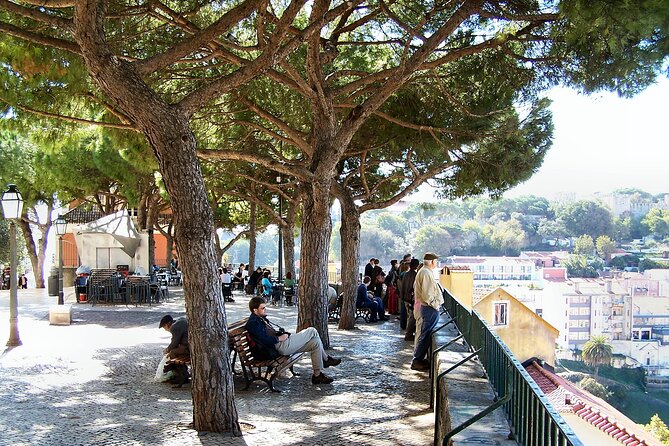
After the neighborhood vibe, the tour turns upward again—this time into gardens. Miradouro São Pedro de Alcântara is a garden viewpoint built in 1864, with two terraces. The layout gives you options: a quick glance and a longer look, depending on how your legs are doing.
Then you’ll see Jardim do Príncipe Real, built in the mid-19th century with a more romantic layout. It’s a slower-feeling pause that helps Lisbon come down from the hills and keeps your final stretch relaxing.
These garden stops are great for photos too, but they’re not just about pictures. They’re where you catch your breath and process what you just saw: squares, church interiors you may or may not enter, and the panoramic viewpoints that explain the city’s shape.
Basílica da Estrela: a neoclassical finish with royal roots
To wrap up, the tour includes Basílica da Estrela. It’s known for its neoclassical beauty and the history tied to Queen Maria I, who inspired the basilica’s construction. It’s the kind of church that looks good from the outside even if you don’t go in.
This final stop works as a palate cleanser after streets and viewpoints. Lisbon ends up in a neat loop: you started with a monument about national liberation, you saw the city’s religious and cultural centers, you climbed for panoramas, and now you finish with a church linked to royal-era Lisbon.
If you still have energy after the tour, this area can also be a useful springboard for an evening walk, because it’s easier to navigate with your bearings already set.
Price and value: what $83.27 per person really buys
At $83.27 per person, you’re paying for three things that matter in Lisbon: time saved, transport that can handle narrow areas, and a local guide to make sense of what you’re looking at.
What’s included:
- driver/local guide
- hotel pickup in the city center on request
- a 100% electric tuk-tuk
- private setup for your group
- mobile ticket
- English offered
What’s not included:
- snacks and tips
- museum entrance fees
So the value question becomes simple: do you want someone to plan stops for you and drive you between them? If yes, the price makes more sense. If you’re the type who enjoys DIY wandering and already knows the neighborhoods well, you might find cheaper options—but you’d lose the packed route and the “easy way to see it all” factor.
Also keep in mind the tour is said to work best with good weather. If weather’s sketchy, don’t force it. If rescheduled or refunded, take the win.
Small practical tips so your tour feels smooth
Lisbon’s hills can be real. This tour reduces walking, but it doesn’t remove the city’s geography. Pack for comfort: breathable layers, grippy shoes, and a light day bag.
Since the schedule uses many stops, you’ll get the most by moving quickly when the guide tells you it’s photo time. At the viewpoints, the difference between a rushed look and a calm one is huge, and these stops are designed for that.
Finally, keep your guide’s priorities in mind. With a private tour, you can usually ask for small adjustments within reason—like spending a touch more time at a viewpoint you love, or speeding through an area you don’t care about.
Should you book this Lisbon Tuk-Tuk Highlights tour?
Book it if you want a high-yield first day in Lisbon. This is ideal for couples, solo travelers, and families who want the orientation value of a guided loop without committing to a full-day walking itinerary.
Skip it or reconsider if you hate bumpy rides on cobblestones or you strongly prefer museum time over street-level viewpoints. Also, if you want lots of paid museum entries, budget separately since entrance fees for museums aren’t included.
If your goal is to come away with a mental map, a handful of unforgettable views, and a feel for neighborhoods like Alfama and Chiado, this private electric tuk-tuk plan is a smart use of limited time.
FAQ
How long is the Lisbon Private Tuk Tuk City Highlights tour?
It runs for about 2 to 4 hours, depending on the route timing and stops.
What does the tour cost?
The price is listed as $83.27 per person.
Is hotel pickup included?
Hotel pickup is offered for city center locations, on request.
Is this tour private?
Yes. It’s a private tour/activity, and only your group will participate.
Is the tuk-tuk electric?
Yes. The tour uses a 100% electric tuk-tuk.
What language is the tour offered in?
The tour is offered in English.
Are museum or attraction entrance fees included?
No. Museum entrance fees are not included.
Do I need good weather?
Yes. The experience requires good weather, and if it’s canceled due to poor weather, you’ll be offered a different date or a full refund.
Can I cancel for a full refund?
You can cancel up to 24 hours in advance for a full refund (cut-off is based on the experience’s local time).