REVIEW · PORTO
Porto Guided Tour to the Historical Center on a Tuk Tuk
Book on Viator →Operated by Portuk · Bookable on Viator
Porto feels bigger when you see it by Tuk Tuk, with a guide steering you through the tight streets and big-view spots. I love that you get a quick hit of the classics plus some less-obvious corners, and the ride includes a Port wine glass to keep the energy up. Guides like Victor and Natalia often add the kind of street-smart context that helps everything click fast.
One thing to plan for: sound can be tricky while you’re driving, and traffic can shift when you reach the more scenic stops.
In This Review
- Key things that make this Tuk Tuk tour work
- Porto by Tuk Tuk: the fast route to the historic center
- Price and value: what $42.33 buys you (and what it doesn’t)
- Teatro Nacional São João area and the Fernandina Wall: where Porto layers show up
- Cathedral stop and the episcopal zone: Romanesque roots with later makeovers
- São Bento Railway Station: the tile hall you shouldn’t rush
- Praça da Batalha area and Fonte dos Leões: squares that remember everything
- Cordoaria Garden: a needed pause between major monuments
- Torre dos Clérigos and the rococo church cluster
- Noble Cloister and cultural spaces: when old buildings gain new roles
- Palácio da Bolsa and the Arabian Room area
- Livraria Lello, Mercado Ferreira Borges, and the Infante square
- Igreja de São Francisco: the Gothic exterior with a gold interior
- Alfândega Nova do Porto: industrial elegance and museum potential
- Serra do Pilar and the two bridge views: Porto’s geography in one sweep
- How to make the most of your ride (practical tips)
- Should you book this Tuk Tuk tour?
- FAQ
- How long is the Tuk Tuk historical center tour in Porto?
- What is the price per person?
- Is a port wine glass included?
- Are monument entrances included in the price?
- Where does the tour start and end?
- What if the weather is poor or I need to cancel?
Key things that make this Tuk Tuk tour work
- Door-to-door-style convenience: You start at R. de Augusto Rosa and end there, without arranging transfers.
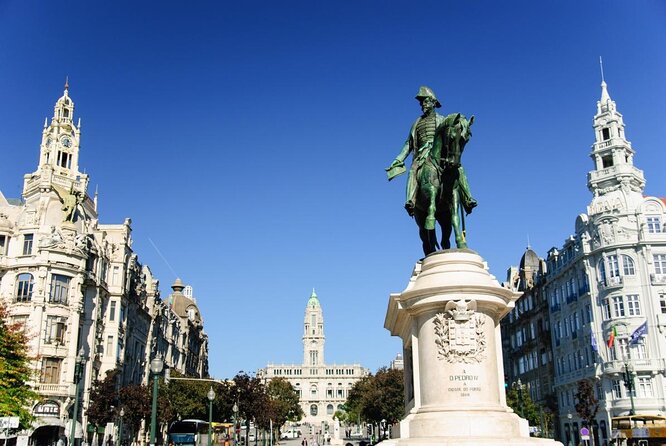
- A smart mix of sights: Cathedral, São Bento Station, Clérigos Tower area, and big riverside landmarks.
- Photo-friendly stop windows: Short timed breaks let you see a lot without getting stuck in queues.
- Port wine is included: A small taste mid-route that fits the Porto mood.
- Private by design: Your group rides together (and if you’re larger, you’ll use multiple Tuk Tuks but keep the same stops).
Porto by Tuk Tuk: the fast route to the historic center
If your days in Porto are tight, this is a practical way to get your bearings. Instead of spending hours deciding where to go next, you follow a set loop through the city’s most iconic and most photographable zones.
The real win is the format. Tuk Tuks can slip into narrower streets and cobbled lanes where normal tour buses feel awkward. That means you spend more time looking at Porto and less time negotiating logistics.
You can also read our reviews of more guided tours in Porto


Price and value: what $42.33 buys you (and what it doesn’t)
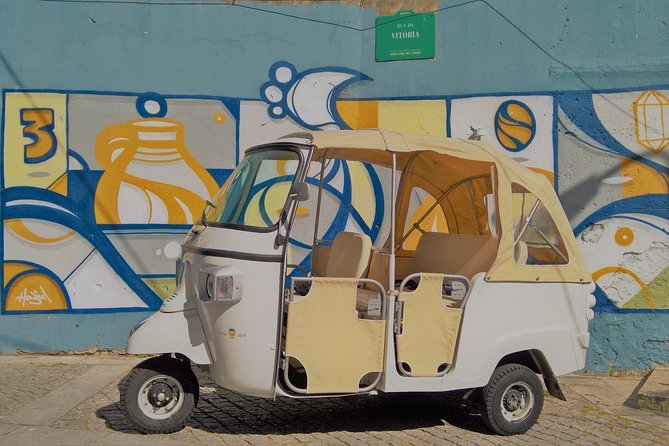
At $42.33 per person for about 1 hour 50 minutes, you’re paying for transport, guiding, and a curated route. You also get a mobile ticket, an English-speaking option, and a port wine glass included.
What’s not included is monument entry. Some stops are free to view, and some major landmarks may require you to purchase tickets if you want inside access. Think of the tour as an efficient sampler: you’ll see a lot from the outside, and you can decide on the spot whether an entrance is worth your time.
It’s also worth noting the booking pattern. This tour is commonly reserved about 27 days in advance, so if your schedule is fixed, I’d secure it early rather than gambling on last-minute availability.
Teatro Nacional São João area and the Fernandina Wall: where Porto layers show up
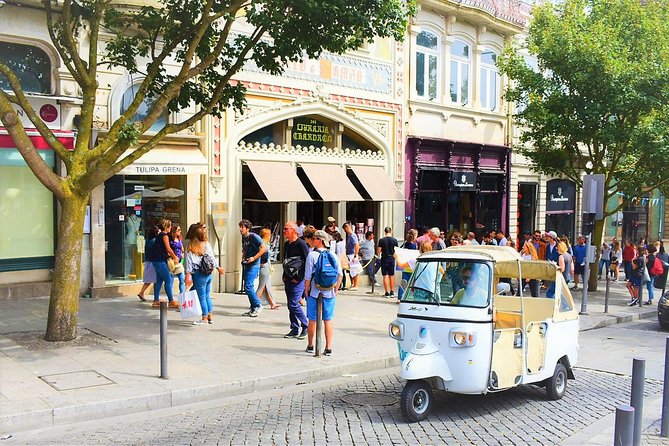
Your ride starts in the realm of Porto’s dramatic theater history and early-1900s architecture. One of the first “wow” moments is the classic building constructed in 1910 on top of ruins from the Real Theatre, which burned down in 1908. The façade includes stylized emblems tied to strong human themes, and it was designed by Marques da Silva. Even if you never step inside, it helps you understand Porto as a city that rebuilds and reuses its own story.
Then you move toward one of Porto’s most guarded secrets: the Muralha Fernandina. Built from 1368 to 1437, it stretches about 3,000 steps with an average height of roughly 30 feet. This is one of those stops that makes Porto feel older than the postcards. You’re seeing military architecture made for defense, not just pretty scenery.
Cathedral stop and the episcopal zone: Romanesque roots with later makeovers
The Catedral do Porto is the next anchor point. Construction dates back to the 12th and 13th centuries, originally in Romanesque style, and it was enlarged and renewed repeatedly over the years. By the 20th century, it was set into an idealized reconstitution of the medieval cathedral. The takeaway for you: even one building can tell multiple eras at once.
Nearby, you’ll pass the Pelourinho connected to the cathedral area. In 1940, buildings around the cathedral complex were demolished, and a terrace was created where a stone monument representing local government was placed in 1945. It’s free to see, and it gives you a clear sense of how the city reshaped itself in the 20th century.
A short stop at the Paco Episcopal adds even more structure to the story. This site likely has roots from the 13th century, with a major remodel in 1737 linked to Nicolau Nasoni. The façade details—arched openings, pilasters, and the bishop’s coat of arms—are the kind of fine points you’d miss if you were simply walking past.
São Bento Railway Station: the tile hall you shouldn’t rush
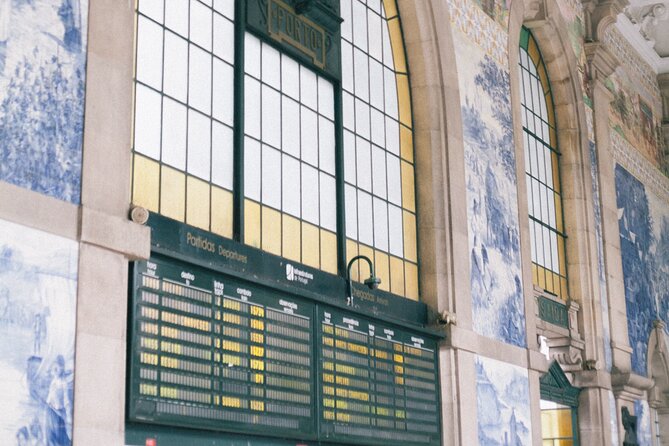
From the medieval and episcopal world, the route shifts to early-1900s Porto glamour at São Bento Railway Station. The station sits in the city center and has a glass and cast-iron roof designed by Marques da Silva.
The big reason to care is inside: the lobby is covered with about 20,000 narrative tiles painted by Jorge Colaço. You can treat this as either a quick stop for photos and orientation—or a slower stop if you want to read the scene-work and let it sink in.
This is one of the free stops on the route, so it’s a good moment to maximize what you get without spending extra on entry.
You can also read our reviews of more historical tours in Porto



Praça da Batalha area and Fonte dos Leões: squares that remember everything
As your Tuk Tuk moves into the more open street-life of central Porto, you’ll hit the square area that began as Praça Nova in the early 1700s. The planning reshaped the zone after medieval walls and palaces disappeared over time. Later, it was known as Praça dos Ferradores when blacksmith workshops operated there.
A palace on the east side, the Palace of Viscondes de Balsemão, ties local life to bigger political storylines. It later served as a guesthouse and hosted Charles Alber from Sardinia during exile. That name connection is why the square exists in your mental map after the ride.
In the middle of the action, the Fonte dos Leões is a quick but fun contrast. It’s a 19th-century fountain cast by the Val d’Osne foundry in France. It’s also a copy of the fountain in Leicester, England, so you get a small reminder that European cities shared ideas in the age of modern infrastructure.
Cordoaria Garden: a needed pause between major monuments
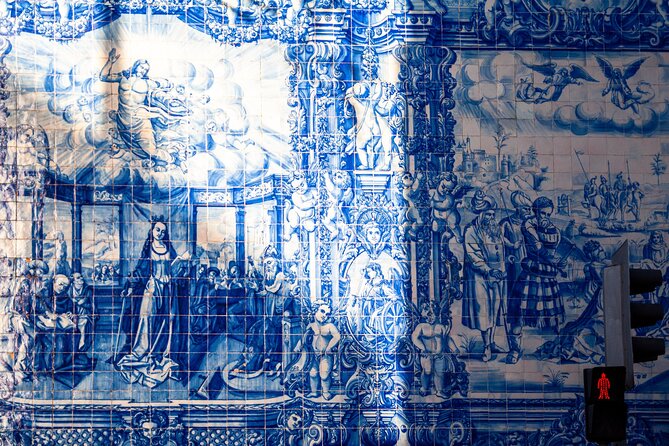
Not every stop is built for speed. Cordoaria Garden, also known as João Chagas Garden, is one of your breathing spaces. The rope-making activity that gave the area its long-term name lasted for roughly 200 years, and the garden later became a public project in the 1860s.
If you’re traveling with kids or you’re tired of stepping in and out of buildings, this is the moment to sit. You’ll see statues including Ramalho Ortigão and António Nobre, plus modern sculptures added later, including Juan Muñoz’s work. Even if you only spend a few minutes, it breaks up the heavier architecture stops.
Torre dos Clérigos and the rococo church cluster
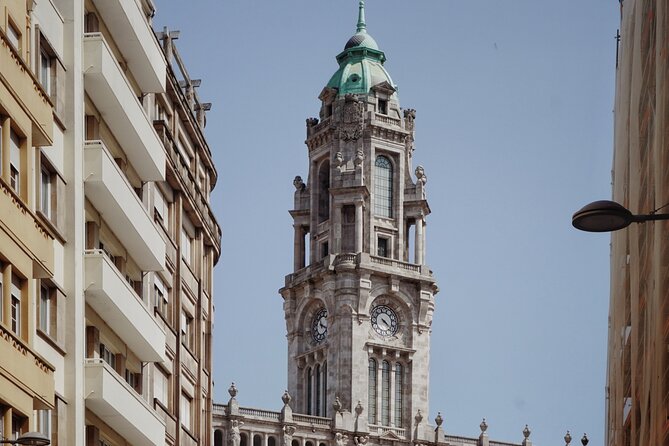
Then you get to one of Porto’s most recognizable silhouettes: Torre dos Clérigos. The Clérigos Church is baroque, and the tower is visible from many parts of the city. The tour stop is short, and entry tickets aren’t included here, so you’ll likely focus on views and exterior details unless you add an entrance separately.
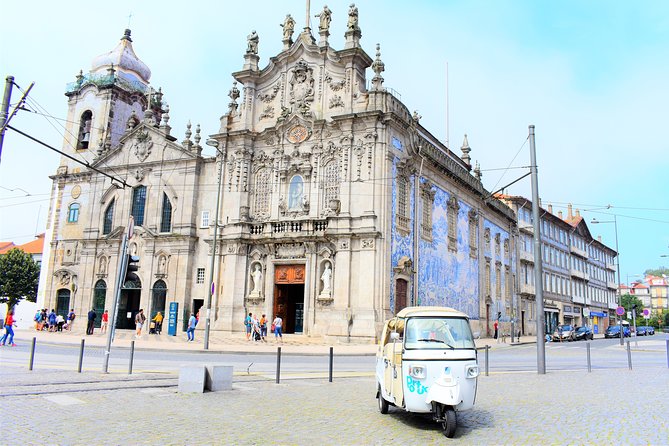
Around this area, you’ll also encounter church façades shaped by Nicolau Nasoni and Porto’s rococo tradition. One church is described as having a classical façade dating to the 1850s, with a Porto rococo altarpiece and national monument status. Another church, built in the second half of the 18th century, is famous for its interior carvings and for a lateral façade covered in tiles in 1912, with drawings by Silvestre Silvestri that reference the cult of Nossa Senhora.
If you’re the type who loves interiors, plan to come back on a different day with more time. If you’re not, don’t worry: the tour still gives you enough context to understand why people obsess over these details.
Noble Cloister and cultural spaces: when old buildings gain new roles
After Clérigos, the route heads toward a preserved monastery complex tied to restorations and later cultural use. The building described here connects to Benedictine monks and even includes space for the Porto National Orchestra and Porto District Archives. During Porto 2001, it received an acoustic shell, and later part of it was assigned to Teatro Nacional de S. João.
Practically, this stop is valuable because it shows Porto as a working city, not a museum that sits still. Even from a distance, you’re seeing how older religious spaces can become cultural venues without losing their scale or character.
Palácio da Bolsa and the Arabian Room area
One of the biggest “worth the ride” stops on the route is Palácio da Bolsa. It’s a neoclassical building from 1842 designed by Joaquim da Costa Lima, and it’s tied to the Commercial Association of Porto. The headline highlight here is the famous Arabian Room, which is why so many people plan an extra visit to go inside.
Admission tickets for monument entry aren’t included, so if you want the full experience of the Arabian Room, you’ll need to budget time and tickets yourself. Still, even an exterior look helps you connect Porto’s business identity to its historic center.
If you have mobility needs, note that Palácio da Bolsa is described as having accessibility for people with reduced mobility through a side entrance.
Livraria Lello, Mercado Ferreira Borges, and the Infante square
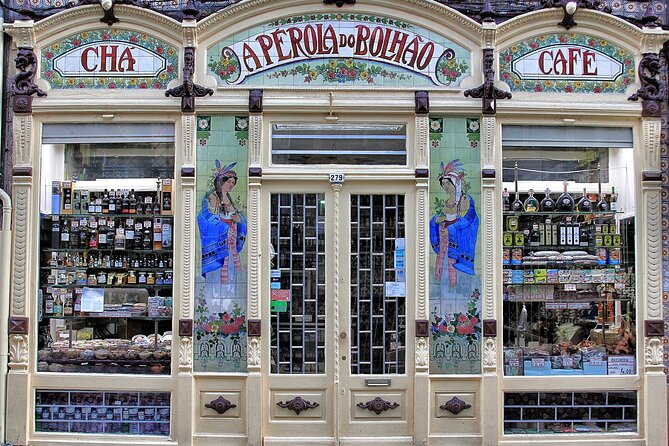
The tour continues along the kind of corridor where Porto feels like it’s written in architecture. There’s a stop for the Art Nouveau library building inaugurated in 1906, known for its neo-Gothic details and a famous staircase. A stained-glass skylight carries the library’s monogram and motto, and the description includes both press coverage and guidebook praise for its interior features. Even if you don’t step in, you’ll see why it keeps showing up on lists.
Next is Mercado Ferreira Borges, built in 1885 with iron architecture and later renovated into an entertainment venue where Hard Club operates. Again, entry depends on what you choose to do, but the building’s structure is the point.
From there you reach Praça da Infante D. Henrique, surrounded by Mercado Ferreira Borges and Palácio da Bolsa. The monument to Infante D. Henrique was started in 1894 and finished in 1900, celebrating Portuguese navigation and faith. This is also where the riverfront energy starts to feel close even before you’re fully at the water.
Igreja de São Francisco: the Gothic exterior with a gold interior
Then you hit Igreja de São Francisco, Porto’s major Gothic temple. Construction began in the 14th century, and what people talk about most is the gilded interior from the 17th and 18th centuries. The church has the Tree of Jesse and catacombs, and it’s been a national monument since 1910 and a UNESCO World Cultural Heritage site since 1996.
The tour stop is brief, and entry tickets are not included for monuments. If you want to see the gilded interior properly, you’ll need to plan that as a separate half-day or at least return later. But as a “why is everyone making a fuss” stop, this one lands.
Alfândega Nova do Porto: industrial elegance and museum potential
A neoclassical building on the route is Alfândega Nova do Porto, designed by engineer Jean F. G. Colson in the 19th century. It has two façades, one facing the Douro river and one facing the city, and the description highlights engineering choices using iron alongside stone, brick, or wood depending on function.
This building later became associated with the future Museum of Transport and Communications. The restoration and adaptation were led by architect Eduardo Souto Moura, and the association also manages a congress center.
For many people, this is the stop where Porto’s identity clicks as both historic and practical. It’s a reminder that the city’s growth wasn’t only built from churches and palaces; it was built from infrastructure.
Serra do Pilar and the two bridge views: Porto’s geography in one sweep
Now for the part that makes the ride feel like a tour, not just a checklist: the viewpoint and bridge sequence.
Mosteiro da Serra do Pilar is a World Cultural Heritage site. Construction began in 1538 and wrapped around 1670. It started as a place for Augustinian Friars and later faced major damage and neglect during the Civil War era. Restoration efforts brought it back, and the church is circular with a dome and a balcony around it. The cloister is also circular with 36 Ionic columns, described as the only example in Portugal. From the terrace, you get panoramic views across Porto and Gaia, including the Cathedral and the D. Luís I bridge.
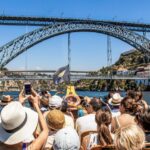
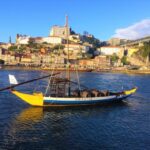
The tour includes another big river highlight: Ponte D. Luís I. The bridge was planned by engineer Teófilo Seyrig (disciple of Eiffel) and inaugurated in 1886. It has two overlapping iron decks and a total length of about 395 meters. The upper deck is used by the Porto Metro, connecting the area near the Cathedral to the Garden of Morro and Avenida da República in Vila Nova de Gaia.
Finally, there’s Ponte da Arrábida, inaugurated in 2003. It was built to replace the upper deck lane of the D. Luís I bridge used now by Metro line D. The bridge has a deck about 371 meters long and 20 meters wide, and it’s described as an elegant Maillart-type arch with a very large arch span (280 meters) noted as a world record by experts. It connects Fontainhas to Oliveira do Douro in Vila Nova de Gaia.
If you’re trying to understand Porto’s layout, this is the “map moment.” After you see these bridges from the right angles, your walking routes around the city make sense.
How to make the most of your ride (practical tips)
A few small things can make the difference between a good tour day and a frustrating one.
First, plan for shifting timing. The route time can change due to local traffic, so don’t schedule a tight appointment right after the tour ends.
Second, keep your expectations realistic about commentary. On the road, the narration can be harder to catch, especially if you’re positioned where wind and driving noise interfere. If sound is important to you, aim to sit where the guide’s voice carries best.
Third, bring weather gear. The operator notes the experience requires good weather, but Porto weather can change quickly. If rain hits, a raincoat helps you stay comfortable through stops.
Finally, if you want inside access at big monuments like the Cathedral, Clérigos Tower, Palácio da Bolsa, or churches with major interiors, treat the tour as your launchpad. You’ll know what to prioritize when you come back.
Should you book this Tuk Tuk tour?
Book it if you want a fast orientation tour that connects Porto’s medieval core to its riverside views. It’s especially good on a first or second day when you need the city’s geography to click. The private setup, English option, and included port wine glass make it feel like more than a drive-by.
Skip or reconsider if you’re coming mainly for interiors and long museum time. Monument entrances aren’t included, and some key stops (like Clérigos Tower area and major churches) are where you’ll want to decide whether buying tickets is worth your extra hours.
If you’re the kind of traveler who likes to learn from good guides, you’ll likely enjoy this. The strong guide energy often turns the brief stops into useful context, whether your guide is Victor, Natalia, Ana, Bernardo, Gonçalo, or Fabian.
FAQ
How long is the Tuk Tuk historical center tour in Porto?
It runs for about 1 hour 50 minutes (approx.).
What is the price per person?
The price is $42.33 per person.
Is a port wine glass included?
Yes. A Port wine glass is included in the tour.
Are monument entrances included in the price?
No. Monument entrance tickets are not included.
Where does the tour start and end?
The meeting point is R. de Augusto Rosa 180, 4000-528 Porto, Portugal, and the tour ends back at the meeting point.
What if the weather is poor or I need to cancel?
The experience requires good weather. If it’s canceled due to poor weather, you’ll be offered a different date or a full refund. You can cancel up to 24 hours in advance for a full refund.