REVIEW · LISBON
Lisbon: Graça Church | Convent & Terrace viewpoint access
Book on GetYourGuide →Operated by Sé de Lisboa and Torre da Igreja · Bookable on GetYourGuide
Lisbon’s sky feels closer at Graça. This Graça Church access visit pairs a walk through a centuries-old convent with one of Lisbon’s best panoramic viewpoints. I love the way the tile-filled cloisters make the complex feel human, like it’s still telling stories, and I love that the terrace frames familiar Lisbon landmarks without turning the experience into a noisy stop. The main drawback: the route involves stairs and a climb, so it can feel like a mini workout—especially if it’s windy or chilly.
You also get the kind of inside look you don’t always get with pure viewpoint tickets. I appreciate that you’re not only seeing the city from above; you’re understanding why this place matters, from medieval origins to post-1755 rebuilding. Plan for around an hour total, and remember this is not the right choice if you have trouble with altitude or stairs.
In This Review
- Key points before you go
- Graça Church and Terrace: A Lisbon View With Context
- A Simple 1-Hour Plan From Church to Panoramic Terrace
- Entering the Convent Complex Opened by the Graça Community
- Cloister and Tile Panels: Where the Complex Feels Personal
- Church Highlights: Gilded Woodwork and Grisaille Ceiling Paintings
- The Terrace View That Names Lisbon for You
- Price and Value: What $7 Buys You in Lisbon
- Timing, Tickets, and Your Best Arrival Strategy
- Who Should Book This Graça Church Convent and Terrace Access?
- Should You Book Graça Church Convent and Terrace Access?
- FAQ
- How long is the Graça Church convent and terrace access?
- What’s included in the $7 ticket?
- Do I need to exchange a voucher?
- What viewpoint landmarks can I see from the terrace?
- What should I bring for this visit?
- Is this experience suitable for wheelchair users?
- Is it suitable if I have altitude sickness?
Key points before you go
- Terrace-first views: You’ll face a top panorama over São Jorge Castle, the Tagus River, and Cristo Rei.
- Convent access beyond the church door: Included entry covers the church, convent areas, and terrace, plus the high choir and upper cloisters.
- Tile lovers will be happy: Look closely at 18th-century tile panels and decorated room details.
- A real timeline in one visit: Started in 1271, rebuilt in the 1500s, damaged in the 1755 earthquake, restored later in a late Baroque style.
- Quiet inside the complex: The church and monastery areas feel calmer than the nearby viewpoint crowds.
- Bring binoculars: They’re listed as a helpful extra for spotting details from the terrace.
Graça Church and Terrace: A Lisbon View With Context
Lisbon has a lot of lookouts, but Graça is different because it gives you a story with your view. You don’t just stand somewhere and point your camera. You move through the Convent of Nossa Senhora da Graça and then step out onto a terrace where the city suddenly makes sense.
What makes this experience click is the combination of scale and intimacy. The complex is imposing, yet you spend time in spaces that feel composed for slow attention—especially the cloister areas and church interior. When you finally reach the viewpoint, you’re not guessing where things are. You see the castle, river, and bridges in a way that helps you read Lisbon.
You can also read our reviews of more tours and experiences in Lisbon.

A Simple 1-Hour Plan From Church to Panoramic Terrace
This visit is timed as valid for 1 hour from first activation, so it’s best to treat it like a focused loop: entry, interior highlights, then up to the terrace. If you arrive ready to move, you’ll feel unhurried. If you arrive late or stop too often for extra breaks, you may feel rushed near the end.
Here’s the flow you should expect:
- You enter the Convent and Church of Graça with included access areas.
- You spend time in the church and convent spaces, including the high choir and upper cloisters.
- After that, you climb up to the terrace for the panoramic viewpoint.
Because the total time is short, you’ll get the most value if you focus on a few details rather than trying to see everything at once. I like to pick one thing to study indoors (tiles, ceiling paintings, or woodwork) and one thing to study outside (the river and bridge alignment, or how the castle sits above the neighborhoods).
Entering the Convent Complex Opened by the Graça Community
The Convent of Nossa Senhora da Graça began in 1271, when construction started at the site then called Almofala. That medieval start matters, because it explains why the complex feels layered: old foundations, changing purposes, and rebuilding after disaster.
At different points, the convent’s dedication shifted—linked to the move from its earlier Saint Augustine invocation to Nossa Senhora da Graça (the information provided points to changes around 1305 or 1362). Then came the modern chapter of survival. The church and convent were destroyed by the 1755 earthquake and later restored in a late Baroque style.
When you’re inside, you can feel that history in the building’s mood. You’re not looking at a single era frozen in time. You’re seeing a place that adapted, recovered, and kept functioning—first tied to religious life, later tied to public devotion.
One historical moment you’ll encounter is the fame that arrived in 1586, when the convent housed the Senhor dos Passos. From the following year, devotion grew through a famous procession that ran from Graça to São Roque. Even if you don’t know Lisbon’s procession routes yet, the fact that this convent became a stage for major religious life gives your visit weight.
Cloister and Tile Panels: Where the Complex Feels Personal
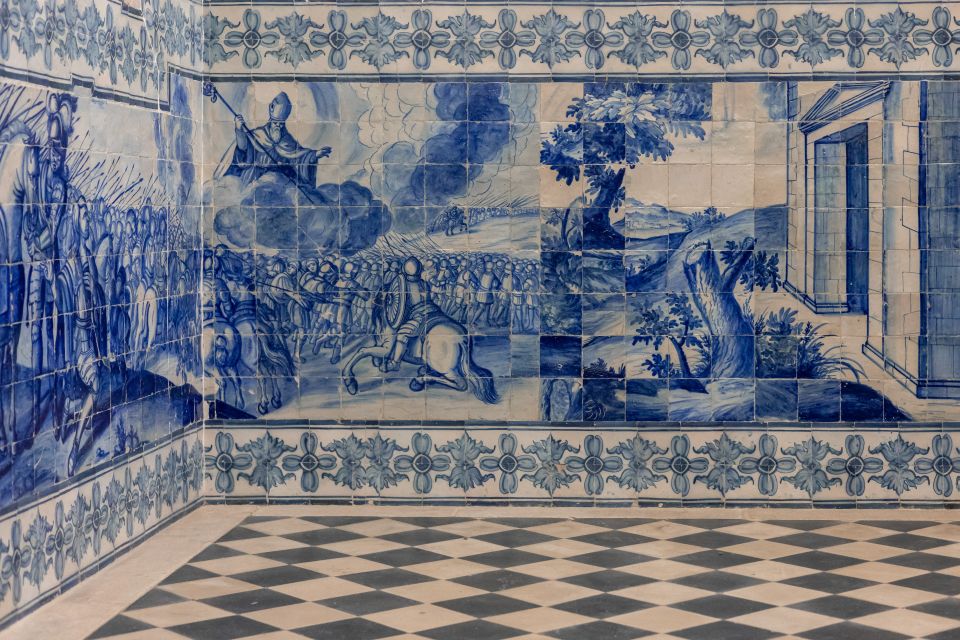
If you care about decoration, plan to slow down here. The cloister and the 18th-century tile panels are exactly the kind of detail that makes a convent visit feel alive instead of purely architectural.
Tiles in Lisbon aren’t just pretty. They often function like visual memory—stories, symbolism, and a sense of who the space served. Here, they add texture to the quiet corridors and open rooms, and they help you understand why people return to Graça not only for views, but for the interiors.
A practical tip: when you’re standing in a tile-heavy area, don’t just take photos straight on. Tilt your camera slightly and then look from the side. You’ll notice how light changes the surface and how certain patterns feel deeper than they look from a distance.
Also, the experience tends to feel calmer in the church and monastery spaces than it does at nearby open-air viewpoints. I like that rhythm: you get a quieter interior before the big outdoor panorama.
Church Highlights: Gilded Woodwork and Grisaille Ceiling Paintings
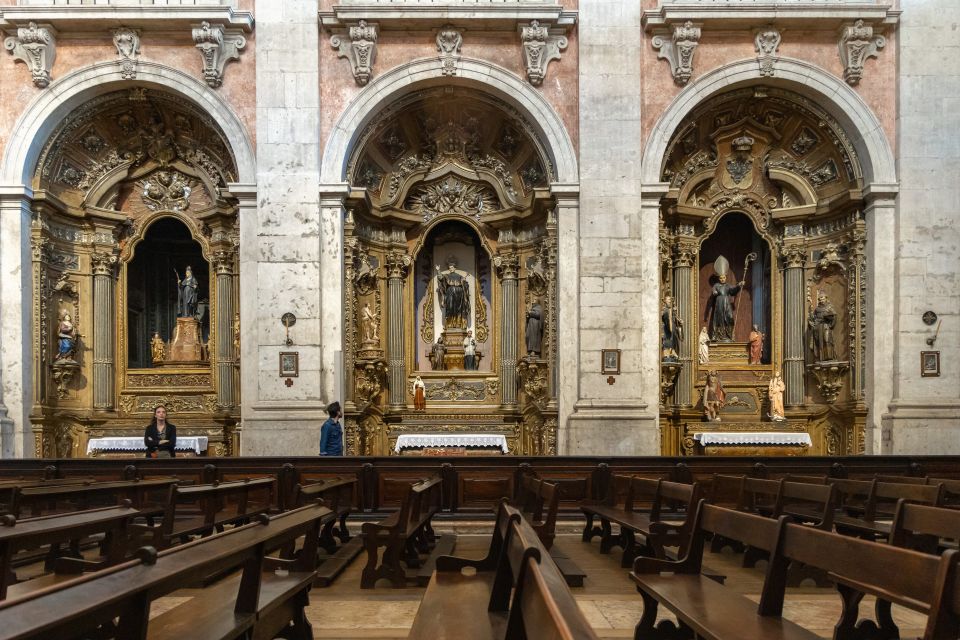
The church interior is where the convent’s story becomes visible in craftsmanship. You’ll see gilded woodwork and ceiling paintings in a style called grisaille—painted in grey tones to mimic sculpture or create a dramatic effect.
This is one of those places where you benefit from looking with intention. If you rush through, the church can feel like “nice interior” and move on. If you give it a few focused minutes, you start to see how the decoration is built to guide your attention upward—toward the ceiling, the altarpiece-like details, and the overall geometry of the room.
Because your time window is short, I suggest picking two targets in the church:
- One decorative element you want to study closely (gilded woodwork)
- One ceiling area where the paintings create depth (grisaille)
You’ll get more satisfaction that way than trying to photograph everything. And you’ll feel less time pressure.



The Terrace View That Names Lisbon for You
Then comes the part most people buy this for: the terrace. From here, you face one of Lisbon’s most visited viewpoints, with panoramic sightlines that help you orient quickly.
The terrace views include:
- St. George’s Castle (São Jorge)
- The Tagus River
- The Old bridge
- Far into the horizon, Cristo Rei (the Christ Statue of Lisbon)
This is a strong value moment. In one outdoor space, you’re seeing both landmarks and geography. The river gives you the scale of the city. The castle gives you the vertical structure. Cristo Rei adds a distant anchor that makes Lisbon feel larger than it does at street level.
Bring binoculars if you can. They’re specifically suggested for this experience, and from a terrace height, binoculars help you spot details around the river and across the horizon without needing to zoom your phone until it turns blurry.
Weather matters here. Even in good conditions, Lisbon can be breezy at elevated points. If it’s cold or windy, you’ll likely want to keep your terrace time purposeful rather than lingering for long minutes.
Price and Value: What $7 Buys You in Lisbon
At about $7 per person for roughly an hour, this doesn’t feel like a “big ticket” Lisbon attraction—and that’s exactly why it’s a smart choice. You’re paying for access to multiple parts of a major historic complex plus a terrace viewpoint, not just one photo spot.
A good way to think about the value:
- If you only wanted a viewpoint, you could pay for an outdoor lookout.
- Here, you also get entry to the church and convent areas, including the high choir and upper cloisters.
- So you’re buying contrast: interior art and history, then outdoor city framing.
The result is a visit that feels “complete” for its time. It’s not a half-day project, and it’s not a rushed drive-by either—if you arrive ready.
Also, this experience includes entry ticket access to the areas mentioned, so you’re not nickel-and-diming yourself into smaller add-ons during the visit. Drinks and merchandising aren’t included, but that’s typical for this kind of site.
Timing, Tickets, and Your Best Arrival Strategy
Even when an experience is simple, the ticket moment can matter. You’ll need to present your voucher at the ticket office and exchange it for an entrance ticket. This doesn’t take long, but I wouldn’t schedule a long buffer if you’re trying to fit multiple plans in the same morning.
Since the visit is valid for 1 hour from first activation, I recommend arriving with enough energy to start immediately after you exchange your ticket. If you pause a long time first, you can accidentally shorten your time inside.
Language support is available with a host or greeter in Portuguese and English, which is helpful if you have questions about where to go next within the complex.
Who Should Book This Graça Church Convent and Terrace Access?
This is a great fit if you want:
- A Lisbon viewpoint that comes with historic context
- Tile and church interior details you can actually take in
- A calm indoor-to-outdoor rhythm instead of only standing outside
You might want to skip it if:
- You’re not comfortable with stairs, because this is not suitable for wheelchair users
- You deal with altitude sensitivity, since it’s noted as not suitable for people with altitude sickness
If you’re visiting in cooler months, dress accordingly. The terrace can feel exposed, and the wind can change how long you’ll want to stay.
Should You Book Graça Church Convent and Terrace Access?
I’d book it if you like practical sightseeing that gives you more than one “thing to see.” The standout for me is the balance: interiors with tiles, gilded woodwork, and grisaille paintings, followed by a terrace that labels the city with landmarks like São Jorge, the Tagus, the Old bridge, and Cristo Rei.
If your only goal is the fastest possible viewpoint photo, this may feel like extra steps. But if you want Lisbon to feel layered—historic, artistic, and panoramic—this is one of the cleaner ways to get all three in about an hour.
FAQ
How long is the Graça Church convent and terrace access?
It’s about 1 hour, and the ticket is valid for 1 hour from first activation.
What’s included in the $7 ticket?
The entry ticket includes access to the Convent and Church of Graça and includes climbing to the terrace, entry to the high choir, and access to the upper cloisters.
Do I need to exchange a voucher?
Yes. You must present your voucher at the ticket office and exchange it for an entrance ticket.
What viewpoint landmarks can I see from the terrace?
From the terrace, you can enjoy panoramic views over St. George’s Castle, the Tagus River, the Old bridge, and far in the horizon the Cristo Rei statue.
What should I bring for this visit?
A camera is useful, and binoculars are recommended since they’re suggested for the terrace.
Is this experience suitable for wheelchair users?
No. It’s not suitable for wheelchair users.
Is it suitable if I have altitude sickness?
No. It’s not suitable for people with altitude sickness.