REVIEW · LISBON
Lisbon El Cristo-Rei – Private Vintage Sidecar Tour
Book on Viator →Operated by Rétro Tour Lisboa · Bookable on Viator
Lisbon looks totally different from a sidecar, and this ride makes it feel personal. You get a smooth loop of classic Lisbon details, then you shoot across to the Cristo Rei area for major viewpoints and great photo angles. I love how it mixes history you can actually see with the easy joy of cruising by motor and chatting with your guides.
Two things really worked for me. First, the vintage sidecars are comfortable and well set up, with helmets, gloves, and goggles included. Second, the guides were super kind and practical—Stéphane and Frédéric made it easy to adjust where we stopped for photos and the pace of the ride, which turns a fixed tour into something that feels like your trip.
One consideration: this experience depends on good weather, and you are riding outside for much of the time—so if it is windy or rainy, plan to be flexible.
In This Review
- Key highlights worth planning around
- Why a private vintage sidecar feels like the best kind of transport
- Meeting point to city start: R. Garrett to central drop-off
- The early stop: church + archaeology + earthquake traces + Portugal’s water story
- Rua da Bica: the quick tram moment that still feels iconic
- Visconde do Sacavém Palace and its azulejos impact
- Sanctuary of Christ the King: the 15-minute payoff you’ll remember
- Casa da Cerca: a coffee break with a view framed by umbrella pines
- The Tagus crossing and the 25th of April Bridge story you can see
- Price and value: $360.23 per group for two hours
- Who this sidecar tour is best for
- Should you book Lisbon El Cristo-Rei? My take
- FAQ
- How long is the Lisbon El Cristo-Rei private vintage sidecar tour?
- How many people can join per group?
- Where do we meet and where does the tour end?
- Is the tour in English?
- What’s included in the sidecar experience?
- Are admission tickets included for stops?
- Are snacks provided?
- Can I buy the ticket on my phone?
- What kind of weather is needed?
- Is it a private tour?
Key highlights worth planning around
- Vintage sidecar comfort with helmets, gloves, and goggles provided, plus modern touches like phone charging (as noted in guide feedback)
- Christ the King included with time at the sanctuary, not just a quick photo stop
- A flexible feel thanks to the ability to tailor where you linger and where you take pictures
- Portuguese independence to 1974 in one flow at a stop that connects church, earthquake legacy, archaeology, water engineering, and the end of dictatorship
- Belém and the bridge connection via the 25th of April route, letting you reach Cristo Rei fast and pair it with Belém sights
Why a private vintage sidecar feels like the best kind of transport
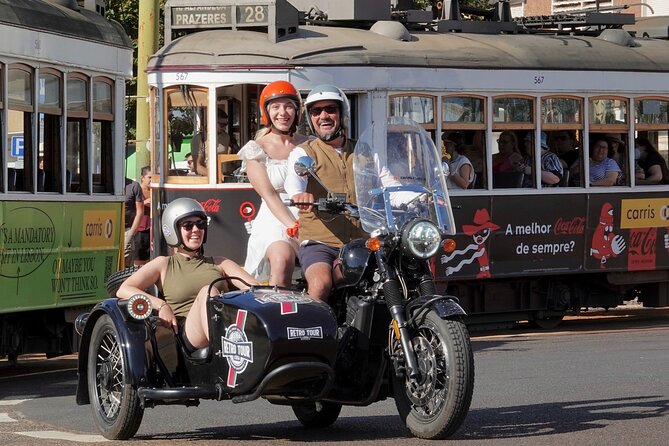
Sidecars are not just a novelty. They change how you move through a city. You feel the turn of a corner before you see it, you get more skyline in your view, and the ride becomes part of the sightseeing instead of something you suffer through between stops.
This one is private, so you are not stuck matching someone else’s pace. That matters in Lisbon, where the best moments are often small: pausing at the right angle of a street façade, getting one extra minute in a viewpoint line, or simply taking a breath on a breezy bridge crossing. Your guides also bring a calm, low-stress approach. In practice, that means you spend your time looking, not worrying about logistics.
You also get a proper equipment setup. Helmets, gloves, and goggles are included, which takes the edge off the wind and helps you feel secure. In reviews tied to this tour, you’ll see a theme about comfort and the fact that the motorcycles and gear feel new. Even if you are only doing this for a short time, that kind of readiness keeps the experience smooth.
You can also read our reviews of more private tours in Lisbon



Meeting point to city start: R. Garrett to central drop-off
You start near R. Garrett 88 (1200-204 Lisboa), and the tour can end at Praça do Comércio or another central drop-off area depending on what works best. That’s a smart setup for visitors because Praça do Comércio is a natural hub. It’s easy to continue on foot from there toward the waterfront, or to connect with the rest of your day.
Because it’s a private sidecar tour, pickup style matters. Having a tour that includes private transportation is especially helpful in Lisbon. You avoid the back-and-forth of figuring out where to meet, then how to get to the next stop. Instead, you ride as a group from highlight to highlight.
Another practical note: it’s offered in English, and the tour uses a mobile ticket. That makes arrival simpler, especially if you are bouncing between other Lisbon sights.
The early stop: church + archaeology + earthquake traces + Portugal’s water story
The first sightseeing block is the kind of stop that makes a city feel layered. You are looking at a 14th-century church that connects to the preserved independence of Portugal, then you move through earthquake context and archaeology evidence tied to Portuguese soil—and even finds associated with other places, including Peruvian mummies. That mix sounds unusual, but it works because it tells you how Lisbon survived, rebuilt, and collected its identity over time.
Next comes the water story, shown through a fountain that illustrates the aqueduct system. The big detail to remember is the scale: around 1730, the system included galleries totaling roughly 58 km, designed to move water so the city west of Lisbon—areas such as Bairro Alto through Ajuda, Belém, and Amoreiras—could rely on it. This is the kind of engineering moment most travelers skip, but it makes everything else click. When you know where the water came from, you understand why certain neighborhoods grew and how the city functioned.
Finally, you get a moment tied to the end of the dictatorship in 1974. You hear about Marcello Caetano, who took over after Salazar in 1968, and how he was deposed and sent to Brazil. This isn’t abstract politics. It’s presented as a place in the city, which is why it lands. You finish the early stage with a stronger sense of Lisbon’s timeline than you would get from a quick walking photo spree.
Potential drawback here: the information density is high. If you love history but prefer fewer concepts per stop, you might want to ask Stéphane or Frédéric to slow down or focus on the single thread you care about most—independence, the earthquake, water engineering, archaeology, or 1974.
Rua da Bica: the quick tram moment that still feels iconic
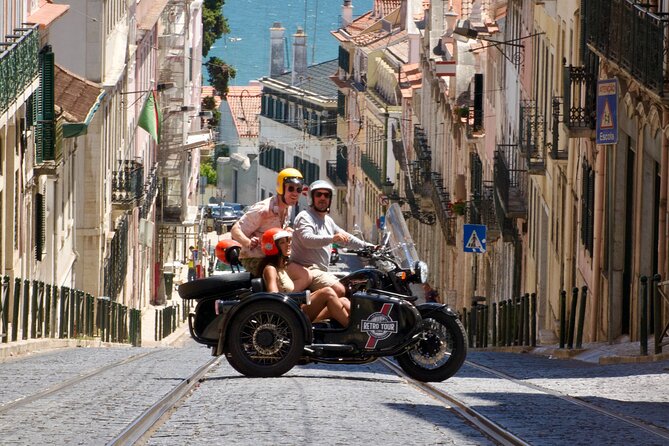
Then you hit Rua da Bica, one of Lisbon’s poster-child street scenes. You get about five minutes, and the big draw is that iconic view of the yellow tram. It’s short, but that’s the point. You are not trying to solve the whole tram story. You’re snapping that classic Lisbon image while the guide sets you up for the next bigger viewing angle.
This is a good stop for two reasons. First, the time window works with the flow of a sidecar ride—no one wants to lose half the tour waiting. Second, the short pause gives you a reset moment. Your body can adjust from riding, you can check your camera settings, and you can be ready for the next transfer.
Tip: since the time is brief, decide quickly where you want your photo and stand in the right place rather than wandering.
Visconde do Sacavém Palace and its azulejos impact
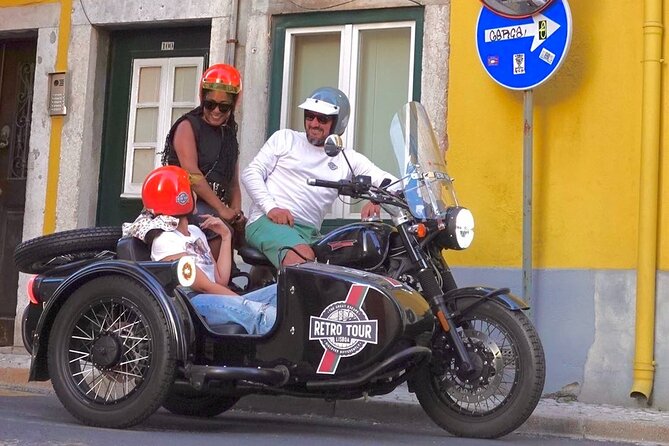
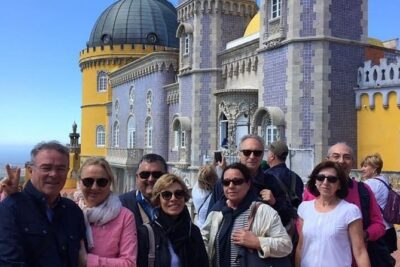
At the Visconde do Sacavém Palace, you’re treated to the kind of Lisbon beauty that rewards close attention. The palace is known for magnificent azulejos—the painted ceramic tiles that tell you a lot about aesthetics and wealth in different eras. It’s also classified as municipal heritage, which helps explain why it is treated as something worth preserving.
One detail I liked from the tour information: it was built in just three years, from 1897 to 1900. When a building gets that much done so fast, you can feel the ambition behind it. You don’t need a long lecture to understand why it’s special—once you’re there, the tiles and façade do the talking.
Time-wise, this stop is designed to fit into the arc of the tour rather than turning into a full museum morning. That makes it ideal if you are mixing big landmarks with decorative city layers.
A consideration: if palace interiors or museums are your main goal, you may want to pair this sidecar ride with a longer standalone visit later. This tour focuses more on variety and movement.






Sanctuary of Christ the King: the 15-minute payoff you’ll remember
Now comes the crown moment for many people: the Sanctuary of Christ the King. You get about 15 minutes, and the admission ticket is included, so you’re not juggling extra steps.
The story behind it is part of the experience. In the 1930s, the cardinal who later shaped the idea had visited Corcovado in Brazil, and the thought was to bring that kind of Christian protection symbol into Lisbon. The statue’s shape took form between 1949 and 1959, after World War II.
Why the backstory matters: it turns a view into a conversation about cultural connections. You’re standing in Portugal looking at a structure inspired by Brazil, which is a neat reminder that Lisbon’s identity has always been tied to the wider world.
Practical tip for your time there: 15 minutes is enough for one main viewpoint plus a few photos, but not for wandering endlessly. Choose one key viewpoint for the best Cristo Rei angle, then use the rest for photos and small details.
Casa da Cerca: a coffee break with a view framed by umbrella pines
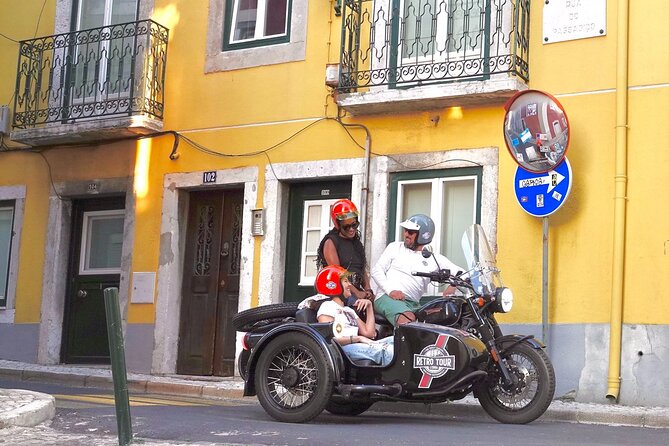
Next is the Casa da Cerca Contemporary Art Center, with about 10 minutes. Yes, it’s short, but you’re not there just for a drink. The setting matters: you get coffee and a view framed by umbrella pines, plus an art-gallery stop that makes the break feel like part of the day rather than a detour.
This stop is one of the best “reset points” on the tour. Riding a sidecar is fun, but your senses are on. A quick coffee pause helps you slow down, regain comfort, and look at Lisbon from a more restful perspective.
What you’ll like here: the mix of contemporary space with Lisbon atmosphere. You get the urban energy in the prior stops, then a calmer pause before you end up back around the river zone.
If you prefer tea over coffee, or you’re picky about what you drink, you might want to plan what you’ll order quickly once you’re there, because the time is limited.
The Tagus crossing and the 25th of April Bridge story you can see
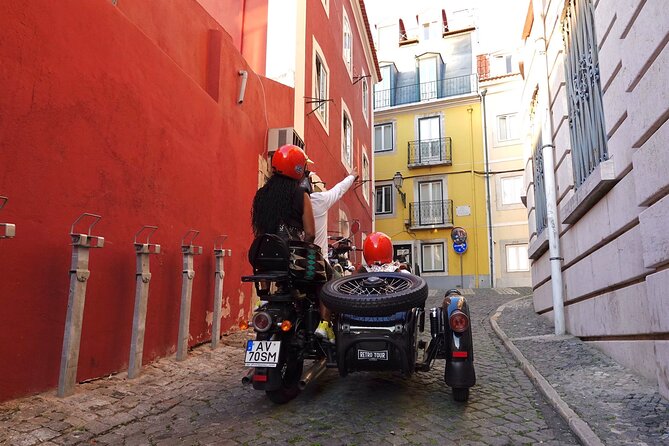
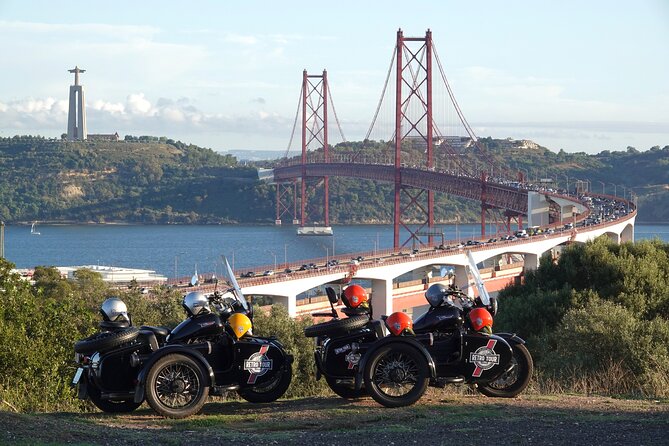
One of the biggest reasons this sidecar format gets rave moments is that it doesn’t just stay in Lisbon center. The route connects you with the estuary quickly. The payoff is being on the ride while you cross the water, not only looking at the bridge from one side.
The bridge story is part of the ride itself. Construction spans 1962 to 1966, and an American company, US Steal Company (listed as SF Point Builders), won the tender. The bridge was designed to make exchanges between the two banks of the Tagus more fluid. And the names reveal the political shift over time: it was called Bridge over the Tagus, then Salazar Bridge, and today it’s known as 25th of April Bridge.
This is the kind of context that makes a famous structure feel less like a postcard. When you know it changed names and functioned as a connector, you start paying attention to how your route changes the city you’re seeing.
Also, the ride setup helps. Sidecars let you talk while moving. In the reviews tied to this tour, people liked the ability to chat with the guide even while riding. That turns transit into a guided conversation rather than just a transfer.
Price and value: $360.23 per group for two hours
At about $360.23 per group (up to 2 people), this is not the cheapest way to do Lisbon. But private sidecar tours cost money because you’re paying for vehicle, driver/guide time, and a tailored, small-group experience.
Here’s why I think it can feel like good value anyway:
- You pay per group, not per person. If you are traveling as a couple, the cost per person can feel more reasonable.
- You get private transportation plus the equipment set (helmet, gloves, goggles), which adds real comfort and reduces hassle.
- You cover multiple areas efficiently in about two hours, including a viewpoint-heavy landmark (Cristo Rei) and decorative city stops (like azulejos).
- The guides can help you personalize where you linger. That flexibility is often the difference between a tour you watch and a tour you enjoy.
One practical comparison: if you were to DIY this, you would still spend time on transportation, ticketing, and figuring out the exact best moments for photos. You might save money, but you’d likely spend more energy. This tour buys you time and ease.
If you are solo, the price per person can feel steeper. In that case, it might be better to pair with a friend if possible.
Who this sidecar tour is best for
This experience is ideal if you want three things at once:
- You like classic Lisbon landmarks, but you don’t want a slow walking day.
- You want a private guide feel without spending all day in one museum.
- You enjoy being outside and moving, with the fun factor turned up.
It also works well for people who like interaction. In particular, the kindness and easy communication from Stéphane and Frédéric comes through clearly—this is the kind of tour where asking questions feels normal, not rushed.
If you hate any wind or have limited comfort riding outside, you might prefer a more sheltered day tour. This isn’t a mostly indoor experience.
Should you book Lisbon El Cristo-Rei? My take
Book it if your ideal Lisbon day includes iconic views, a few signature neighborhoods, and the joy of moving by vintage sidecar instead of sitting on a bus. I’d also recommend it if you want that bridge connection to the Cristo Rei area without spending a full day planning routes.
Skip it or reconsider if you know you will be uncomfortable in outdoor riding conditions, or if you prefer very long time at fewer stops. This tour spreads its time across several meaningful highlights, so it’s built for variety, not for deep museum study.
If you book, do one simple thing: decide what you care about most—Cristo Rei views, azulejos and palaces, or the water and 1974 stories—and ask the guide to keep the pace aligned with your interest.
FAQ
How long is the Lisbon El Cristo-Rei private vintage sidecar tour?
It runs for about 2 hours.
How many people can join per group?
The tour is priced per group and is listed for up to 2 people.
Where do we meet and where does the tour end?
You start at R. Garrett 88, Lisboa and end at Praça do Comércio, or you can be dropped off in central Lisbon or at the starting point.
Is the tour in English?
Yes, it is offered in English.
What’s included in the sidecar experience?
Helmets, gloves, goggles, private transportation, and support are included.
Are admission tickets included for stops?
Admission is included for the Sanctuary of Christ the King, and included for Casa da Cerca. Rua da Bica is listed as free.
Are snacks provided?
No, snacks are not included.
Can I buy the ticket on my phone?
A mobile ticket is included.
What kind of weather is needed?
The experience requires good weather. If it is canceled due to poor weather, you’ll be offered a different date or a full refund.
Is it a private tour?
Yes. It is private, and only your group participates.