REVIEW · LISBON
Tuk Tuk Lisbon: Exploring Urban Art
Book on Viator →Operated by TukGuide Portugal · Bookable on Viator
Lisbon’s street art deserves a fun ride. This Tuk Tuk urban-art tour threads together major mural spots in a short, 2 to 3 hour window, using private transport and an English-speaking private guide. You’ll also get practical pick-up help near the historic center, plus a route that’s paced for seeing art up close, not rushing past it.
I especially like the way the guide connects each artwork to place and context, so you’re not just looking at color. Two standouts for me are the art stops that demand attention (like the big sculptural Pichi&Avo figure) and the chance to learn names and styles as you go, including artists like André Saraiva and Vhils.
One thing to consider: this isn’t the best fit for everyone. It’s not recommended for pregnant women or people with reduced mobility, and children under 7 aren’t allowed, so plan based on your group’s needs.
In This Review
- Key points before you go
- Why a tuk tuk fits Lisbon’s street art
- Price, timing, and booking smart
- Street-art route: Santa Apolónia, Santa Clara, Graça, and Lx Factory
- Stop 1: Calçada de Santa Apolónia and the Pichi&Avo sculptural mural
- Stop 2: Campo de Santa Clara / Feira da Ladra wall and André Saraiva’s tile mural
- Stop 3: Travessa das Merceeiras and Vhils’ hidden face
- Stop 4: Graça district literary faces with Eime and Mariana Dias Coutinho
- Stop 5: Avenida Fontes Pereira de Melo and international artists on vacant buildings
- Stop 6: Lx Factory and Bordalo II’s garbage-bee energy
- Guides matter: Nuno, Filipe, and Pifas’ practical storytelling
- Pickup and meeting points: avoid the usual Lisbon timing chaos
- What’s included vs. what you’ll need to plan
- Who this tuk tuk urban art tour is best for
- Should you book Tuk Tuk Lisbon: Exploring Urban Art?
- FAQ
- How long is the Tuk Tuk Lisbon urban art tour?
- What is the price per person?
- Do they offer pickup in Lisbon?
- What’s included in the tour price?
- Is the tour suitable for children?
- Are there any restrictions for mobility or pregnancy?
Key points before you go
- Private guide + private tuk tuk: just your group, so you can ask questions and set a calmer pace.
- Photo-friendly timing: if traffic allows, guides can help you pause for pictures.
- Big-scale art, short time: major murals and installations are packed into a 2 to 3 hour route.
- Story-driven street art: you’ll learn the why behind the work, not just the what.
- Comfort and limits: designed for up to 6 seats (capacity by weight also applies).
- Pickup options near the historic center: hotels, select rental stays, cruise terminals, and nearby meeting areas.
Why a tuk tuk fits Lisbon’s street art
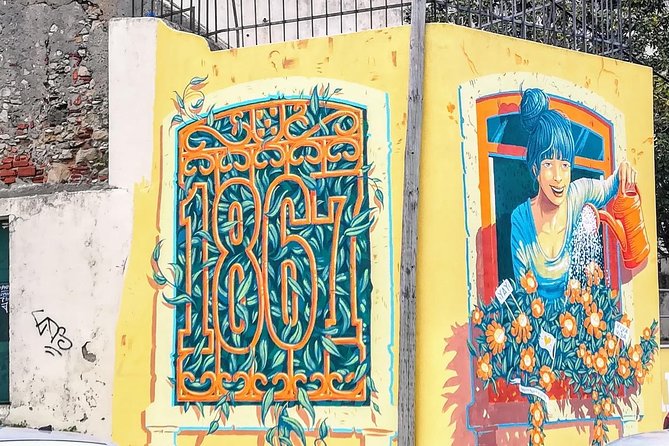
Lisbon is made for walking, but street art is a different animal. Murals sit on long walls, tucked corners, and streets that can be tricky to cover fast on foot. A tuk tuk solves that. You get movement without losing the chance to stop and look closely when something catches your eye.
Also, this tour is built around urban art styles that change street by street: graffiti-tag layering, wheat-paste grit, tile mosaics, carved faces, and large-scale international collaborations. Sitting on a small vehicle keeps the rhythm up while still letting you focus at each stop.
You’re paying for more than transportation, too. The included private guide turns the route into a guided lesson, with artists’ names, techniques, and local connections. That matters, because many of Lisbon’s best street art is partly visual and partly cultural—politics, identity, and local pride get mixed right into the imagery.
You can also read our reviews of more tours and experiences in Lisbon.



Price, timing, and booking smart
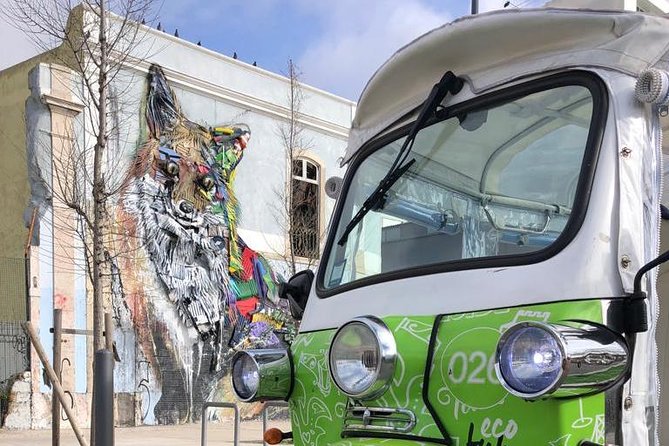
At $93.73 per person for about 2 to 3 hours, this isn’t a budget “hop-on hop-off” add-on. It’s closer to a premium neighborhood experience. The value is in three places:
- You’re not waiting in crowds: it’s private, only your group.
- You get context: the guide connects each artwork to Lisbon and to the artists’ style.
- You’re saving logistics time: private transportation plus pickup help you avoid the guesswork of meeting distant street corners.
If your schedule is flexible, I’d book earlier rather than later. This tour is typically booked about 45 days in advance, which tells me popular days can fill up.
Tip: if you want the most relaxed experience, plan to be ready at the agreed pickup point a bit early. With urban traffic and photo stops, a few minutes of delay can matter.
Street-art route: Santa Apolónia, Santa Clara, Graça, and Lx Factory
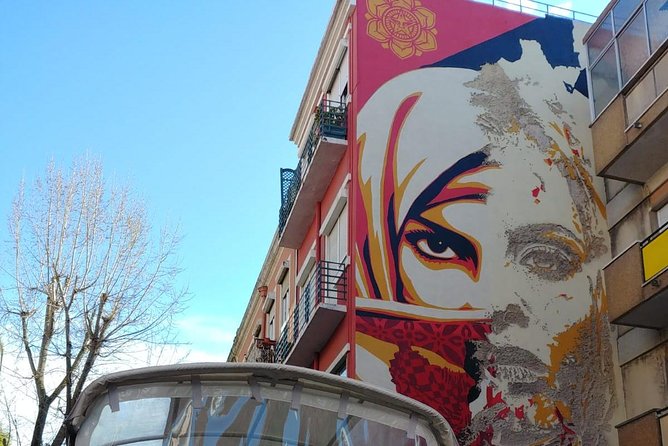
The route is designed to feel like you’re moving through Lisbon layers: classic-looking streets mixed with modern rebellion, then a jump into tile craftsmanship and a later hit of creative-industry energy.
Stop 1: Calçada de Santa Apolónia and the Pichi&Avo sculptural mural
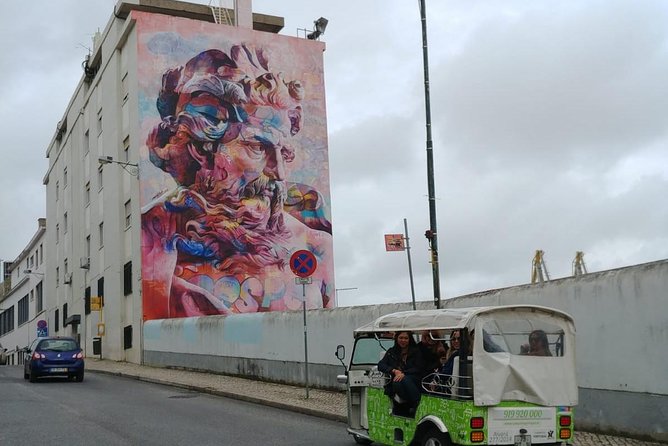
Your first wow moment is on the sidewalk of Santa Apolónia along Calçada de Santa Apolónia. Here you’ll see a large sculptural figure set on top of dense graffiti-style tags. The artists are Pichi&Avo, a Spanish duo known for pairing classic art references with graffiti’s raw, rebellious side.
What makes this stop worth your time is the contrast. You get coarse brush energy in the tags, but a more careful approach in the figure’s drawing. Up close, you can start reading the mural like a conversation between styles.
Practical tip: if you care about photos, ask the guide to help you position around the most photogenic angle. A tuk tuk pause usually makes it easier than trying to improvise on a busy sidewalk.
Stop 2: Campo de Santa Clara / Feira da Ladra wall and André Saraiva’s tile mural
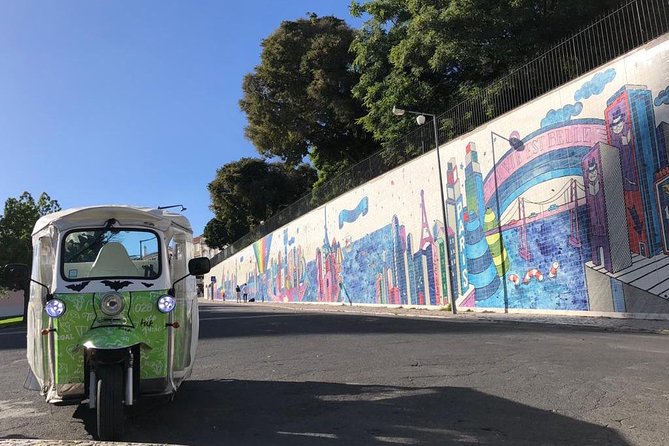
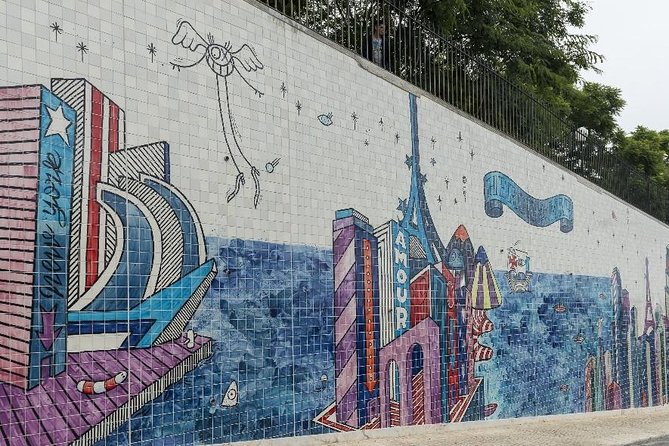
Next comes a totally different medium: tiles. In the Santa Clara Field area, an old wall at Jardim Botto Machado has been transformed by André Saraiva into a huge tile mural covering about 170 meters of wall, with around 53,000 tiles spread across 1,000 m².
This is the stop where you slow down a bit mentally. Tile murals reward patient looking because details show up as you move. You’re not just seeing color—you’re seeing structure, repetition, and craft.
A small drawback: the scale can feel visually overwhelming at first. If you want it to click, focus on one section, then let the rest of the mural broaden your view.



Stop 3: Travessa das Merceeiras and Vhils’ hidden face
Lisbon’s urban art isn’t always announced with giant murals. Sometimes it’s tucked away. In Travessa das Merceeiras, you’ll look for a face carved by Vhils (real name Alexandre Farto), one of the early faces he carved in Lisbon.
This kind of street art is different because it plays with depth. Instead of flat paint, you get carving-like forms that make the wall itself part of the artwork. The “hidden in plain sight” feel is the point—walk away looking for it in the next side street, because your eyes will start catching the technique.
Stop 4: Graça district literary faces with Eime and Mariana Dias Coutinho
Then you shift toward stories tied to Lisbon’s neighborhoods. In the Graça area, artists honored figures from Portuguese national literature with works connected to the district’s streets and viewpoints.
You’ll see:
- Sophia de Mello Breyner portrayed by Eime on Rua Josefa de Óbidos
- Natália Correia and Florbela Espanca shown on Travessa do Monte in a work by Mariana Dias Coutinho
And nearby, there are viewpoints around Graça and Senhora do Monte, which can help you connect the art to how the neighborhood sits in the city.
Why I like this stop: it shows urban art doing more than decorating. It’s mapping cultural memory onto real streets—so you’re seeing the neighborhood through literature, not just through architecture.
Stop 5: Avenida Fontes Pereira de Melo and international artists on vacant buildings
On Avenida Fontes Pereira de Melo, you’ll encounter a striking mural set across three vacant buildings, created by major international names:
- Os Gémeos (Brazil)
- Blu and Eric Il Cane (Italy)
- Sam3 (Spain)
This work was also recognized as one of the 10 best in the world by the British newspaper The Guardian. Even if you don’t follow that kind of ranking, it signals something useful: this is not a small local tag. It’s a large, ambitious work that’s meant to be seen from the street and absorbed as a whole.
Consideration: vacant-building murals can be partially affected by where you can safely stand and what angles are easiest. Go with your guide’s positioning and expect the best views might come from slightly different spots than you’d choose on your own.
Stop 6: Lx Factory and Bordalo II’s garbage-bee energy
The ride ends in a more modern creative-world setting: Lx Factory. Here, you’ll find plenty of street-art style works by well-known names, including Bordalo II, famous for sculptures made from recycled materials.
This is where the tour shifts from “learn the wall” to “see the art ecosystem.” The large bee made of garbage is the kind of piece that makes you look twice, because it flips the usual idea of what street art can be.
If you like shopping districts that also feel artsy, this stop is a nice closer. If not, it still works because it adds variety after the mural-focused earlier stops.
Guides matter: Nuno, Filipe, and Pifas’ practical storytelling
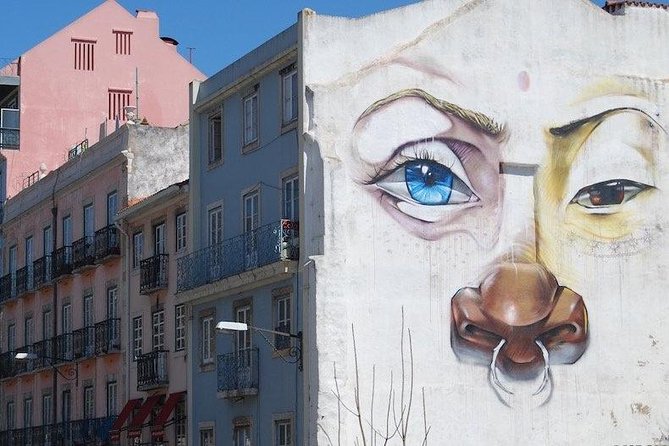
The strongest part of this kind of tour is the guide. In the feedback for this experience, guides like Nuno, Filipe, and Pifas show a clear pattern: they connect the art to the city in a way that makes Lisbon feel more readable.
Here’s what you can realistically expect from a good guide on this route:
- Artist context: not just naming painters, but explaining styles—how a technique fits the artist’s identity.
- City context: where the work sits in Lisbon’s cultural geography.
- Photo planning: feedback notes that you can sometimes choose where the guide stops for photos, especially if traffic allows.
- Smart pauses: some guides also build in time for viewpoints and even a pastry stop, when the route and timing line up.
You’ll enjoy this more if you show up curious. If you want only quick photo snapshots, you might feel like there’s a lot to learn. If you like “why it’s here” and “what the artist is doing,” you’re in the right place.
Pickup and meeting points: avoid the usual Lisbon timing chaos
The tour offers pick-up at all Lisbon hotels and Airbnbs near the historic center, plus pick-up in the three cruise terminals and at nearby restaurants or other convenient spots close to the historic center.
If you prefer a fixed meeting point, the provider suggests:
- TimeOut Market
- Alto do Parque Eduardo VII
That’s helpful because those are easy places to navigate, especially if you’re using public transportation before the tour. The activity also ends back at the meeting point, so you’re not left guessing how to get home.
Practical tip: if you’re coordinating with multiple people in your group, choose one person as the point of contact for timing and location. Private pickup is smooth when everyone is synced.
What’s included vs. what you’ll need to plan
Included:
- Guided tour
- Private guide
- Private transportation
Not included:
- Food and drinks
- Monuments tickets
For most art-focused stops here, you shouldn’t expect to need monument tickets to enjoy the murals themselves. Still, bring water, especially in warmer months. And if you want a quick food break, plan it outside the tour window or ask the guide what timing makes sense based on traffic.
Who this tuk tuk urban art tour is best for
This is a great match if you:
- want street art with real context
- like moving efficiently through multiple neighborhoods
- enjoy photos but also want help finding the best viewpoints and angles
It’s less ideal if you:
- need accommodations for reduced mobility
- are traveling with very young kids (children under 7 aren’t allowed)
- want a purely self-guided route (this tour is built around a private guide)
Capacity also matters. It’s set up for small groups, with room for up to 6 seats (and weight limits apply). If you’re a larger group, you’ll likely need separate bookings.
Should you book Tuk Tuk Lisbon: Exploring Urban Art?
Book it if you want Lisbon street art packaged in a way that’s easy to manage. The private transport cuts down on coordination stress, and the guide work makes the stops land better than a simple mural walk.
Skip it if you only want quick photos with no explanation, or if your group has mobility needs that don’t match the tour’s limitations.
If you’re on the fence, decide based on this: do you want to understand the art as you see it? If yes, this route is a smart use of a half-day. If you’d rather wander on your own, you might prefer a self-guided plan and spend longer at a few locations you love.
FAQ
How long is the Tuk Tuk Lisbon urban art tour?
It runs about 2 to 3 hours.
What is the price per person?
The price is $93.73 per person.
Do they offer pickup in Lisbon?
Yes. Pickup is offered at Lisbon hotels and Airbnbs near the historic center, in the three cruise terminals, and at other nearby places close to the historic center.
What’s included in the tour price?
You get a guided tour, a private guide, and private transportation.
Is the tour suitable for children?
Children under 7 are not allowed.
Are there any restrictions for mobility or pregnancy?
It’s not recommended for pregnant women or people with reduced mobility. Service animals are allowed.