REVIEW · PORTO
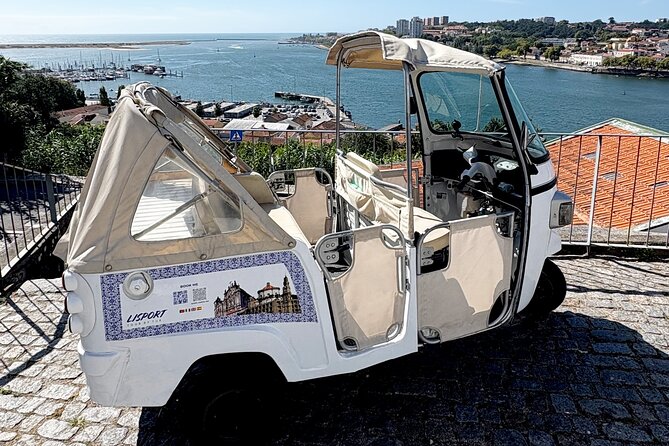
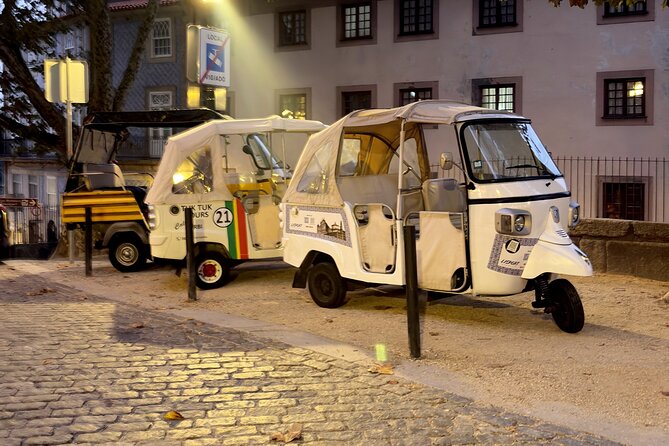
Tours in the Port DE Tuk Tuk
Book on Viator →Operated by LISPORT TRANSFER TOUR · Bookable on Viator
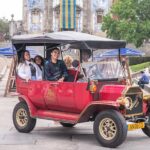
One hour is enough to get Porto’s best ideas in your head. This tuk-tuk tour is built for fast orientation and big photo stops, with English guiding and a route through the historic center.
What I like most is the way it keeps you moving without feeling rushed. You get a guided tour that’s easy to tailor, and the stops are chosen so you see the city’s major layers: azulejos, baroque facades, medieval defenses, and Douro river engineering.
The main thing to consider is simple: the timing is short (about 1 to 1 hour 10), so you’ll be looking and learning as you go, not doing long museum-style visits at every site.
In This Review
- Key highlights you’ll feel right away
- Why a tuk-tuk makes sense in Porto
- Meeting at Praça da Batalha: your Porto “map start”
- Teatro Nacional São João: neoclassical grandeur in the plaza
- São Bento Railway Station: 20,000 historic azulejos
- Porto Cathedral (Sé): Romanesque strength with later layers
- Dom Luís I Bridge: the Eiffel connection over the Douro
- Fernandine Walls: the medieval defense you can still trace
- Igreja de Santo Ildefonso: the azulejo facade that demands a photo
- Rua de Santa Catarina and Porto’s shopping pulse
- Avenida dos Aliados and Porto’s 70-meter clock landmark
- Praça de los Leones: lions, Lello, and student energy
- Carmo and Carmelites churches: baroque details and the narrow house
- Hospital de Santo António (Misericórdia): English neoclassical in granite
- Jardim da Cordoaria: from rope-makers to shaded sculpture
- Centro Português de Fotografia: a free museum in an old prison building
- Clérigos Tower: pay once for the 360-degree payoff
- Price and value: why $42-ish can work for you
- Who should book this Porto tuk-tuk tour
- Final call: should you book it?
- FAQ
- How long is the tuk-tuk tour?
- What does the tour cost?
- What language is the tour offered in?
- Is the ticket delivered digitally?
- Is this a private tour?
- Do I need good weather?
- Is free cancellation available?
- Are service animals allowed?
- Does it include any safety gear?
Key highlights you’ll feel right away
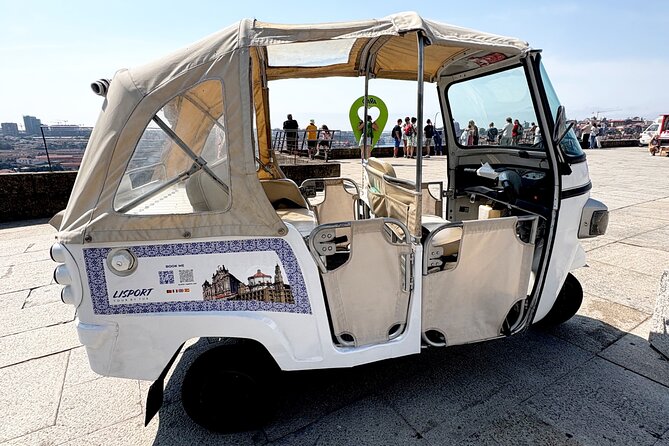
- Flexible pacing with your guide so you can slow down at the spots you care about
- São Bento Station tiles: a 20,000-tile interior you’ll understand fast
- Dom Luís I Bridge: a major Porto icon with serious engineering context
- Baroque + azulejos photo stops like Igreja de Santo Ildefonso
- A tight route that ties Porto to Gaia via the river crossing
- Clérigos Tower viewpoint for a 360-degree sense of the city layout
Why a tuk-tuk makes sense in Porto
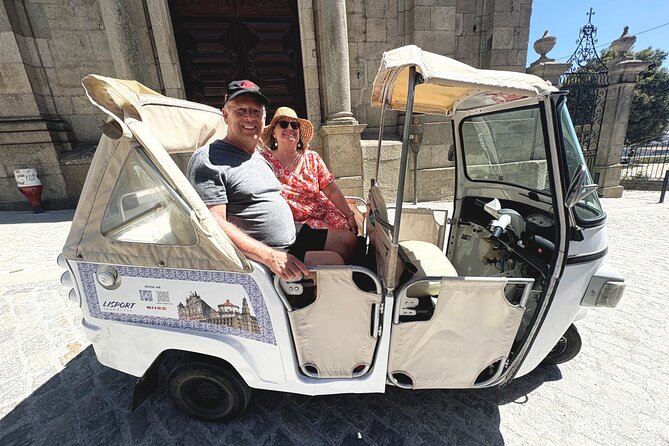
Porto is steep in a way that sneaks up on you. A tuk-tuk keeps the trip fun and stops you from spending your energy purely on stairs and hills. In about an hour, you can cover a lot of ground that would feel slower on foot, especially if you want photos but also want to actually hear the story.
This tour also works because it’s designed around the “look, learn, connect” style of sightseeing. You get repeated city anchors—stations, bridges, churches, and viewpoints—so you start building a mental map. That matters in Porto, where neighborhoods can feel like separate worlds until you connect them with a river crossing and a few big landmark streets.
You can also read our reviews of more tours and experiences in Porto.


Meeting at Praça da Batalha: your Porto “map start”
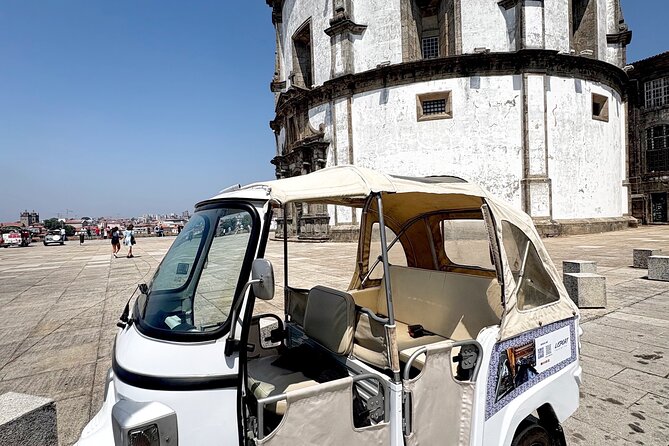
You begin at Monumento ao Rei D. Pedro in Praça da Batalha, then the activity returns you to the same meeting point. That’s a smart start because you’re placed in the historic center, with several major sights clustered nearby.
From here, the tour naturally sets up a rhythm: ride a bit, stop for a key landmark, then move again. If you’re the type who likes to understand where things sit relative to each other, this layout helps. If you’re traveling with mobility limits, the short stops plus vehicle transfer can feel easier than trying to cram the same locations on foot.
Teatro Nacional São João: neoclassical grandeur in the plaza
Right near your first stop area is the Plaza da Batalha and the Teatro Nacional São João (opened in the late 1700s as the Royal Theatre of São João). This building has had a dramatic life: it was first built in 1798, burned in 1908, then rebuilt and reopened in 1920, tied to architect José Marques da Silva—the same architect behind São Bento Railway Station.
Why this stop matters on a short tour: you get a “Porto culture” anchor early. The theatre is neoclassical and Beaux-Arts, with an imposing facade and a richly decorated interior featuring golden frescoes and painted ceilings. Even if you only see parts of the exterior up close, it helps you place Porto as more than viewpoints and food.
São Bento Railway Station: 20,000 historic azulejos
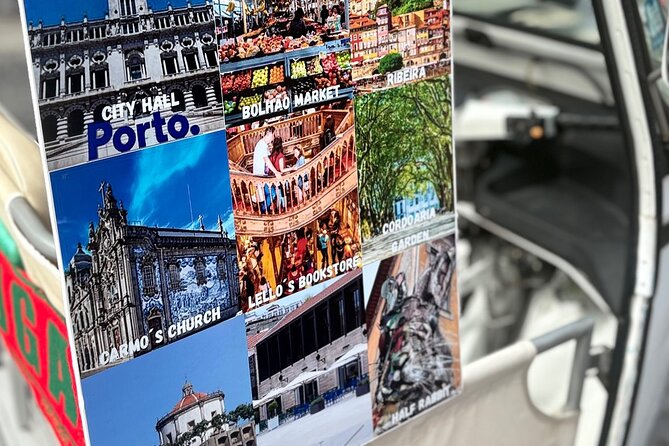
If you want one stop that teaches you Porto’s identity in minutes, it’s São Bento Railway Station. The station building was officially inaugurated on October 5, 1916, and it replaced the older Saint Benedict convent that was demolished for the new structure.
The big draw is the interior covering with more than 20,000 historic tiles (azulejos). These were painted by Jorge Colaço between 1905 and 1908 and depict scenes from Portugal’s history—rural life, transport, and major moments. In the upper atrium, you’ll see inscriptions like Douro and Minho, key rivers tied to the region’s identity.
Practical tip: the station entry is noted as free. So even in a short tour, this is one place where you don’t feel like you need to budget extra time just to pay an entrance fee.
A possible downside: tiles cover a lot of space, and it can be easy to “look at everything” without noticing the details. Ask your guide to point out a few specific tile themes—especially if you’re only getting a quick look—so it lands instead of blurring.
Porto Cathedral (Sé): Romanesque strength with later layers
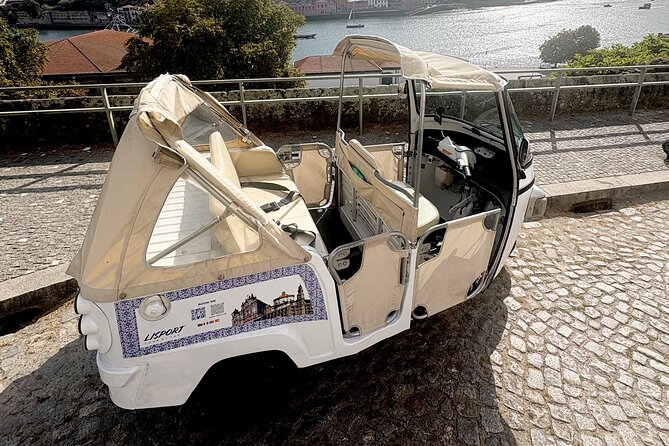
Next up is the Sé (Porto Cathedral) area. This church started in the 12th century in Romanesque style, then got expanded and reshaped over time. The building carries Gothic, Baroque, and Manieristic elements on top of its dominant Romanesque structure.
A couple standout features to listen for:
- The Romanesque rosacea on the facade
- The Gothic cloister, plus Baroque altar work
- The sense that Porto’s religious life and political moments are intertwined here
The Cathedral also has major “timeline” value. It was important during the Christian Reconquest and the consolidation of the Kingdom of Portugal. The story continues later: on the day Dom Pedro IV celebrated Mass before beginning the siege of Porto during the liberal wars, and the See also hosted royal weddings.
On a short tuk-tuk route, this stop is less about long wandering and more about understanding that Porto’s center didn’t develop in a straight line. It grew through centuries of changes, and the cathedral shows the edits.
Dom Luís I Bridge: the Eiffel connection over the Douro
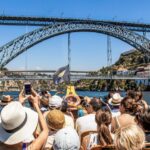
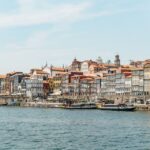
Then the tour shifts to the river with Dom Luís I Bridge, connecting Porto and Vila Nova de Gaia. It’s placed between the Ribeira do Porto and the Cais de Gaia, with direct views toward the wine warehouses—so you get a Porto-to-Gaia “before and after” perspective in seconds.
This bridge opened in 1886 and was designed by engineer Théophile Seyrig, who partnered with Gustave Eiffel (yes, the Eiffel Tower).
Here’s what’s especially useful to understand in a quick stop:
- It’s a double-deck bridge: the upper deck is used by Port Metro line D and pedestrians, while the bottom deck handles cars and pedestrians.
- The central iron arc is 172 meters long, and the maximum height is about 45 meters above the river.
- It’s classified as a National Monument since 1982.
If you want photos, don’t wait until the last second. The bridge is often used as a panoramic viewpoint, especially from the top board, so plan your photo moment early while you still have the guide’s timing.
Fernandine Walls: the medieval defense you can still trace
Porto’s medieval story shows up in the Fernandine Walls, built in the 14th century during the reign of D. Fernando I. These granite walls replaced and enlarged older Romanesque defenses that no longer matched the city’s growth.
What makes this stop interesting is that you can see defense logic in a modern city:
- It protected Porto from invasions and controlled commercial entrances and exits.
- The walls had towers and doors, and some stoves were still visible.
- Over time they lost military importance, and in the 19th century much of the wall was demolished for urban expansion.
- Some parts remain, including restored sections and the Postigo do Carvão, described as the only medieval door still existing.
On a short tour, this is a “read the city like a map” stop. Even if you don’t walk far, your guide can point out surviving sections so the wall stops being trivia and turns into something you can spot later on your own.
Igreja de Santo Ildefonso: the azulejo facade that demands a photo
Then it’s straight into one of Porto’s most photographed church facades: Igreja de Santo Ildefonso. It sits in the Plaza da Batalha area near key landmarks, and the church was built between 1709 and 1739.
It’s Baroque with proto-rococo influence and has a granite structure with two towers and a curved fronton. The interior is described as Baroque golden work, including painted and decorated details like side altars and an 18th-century carved wood retable.
The facade is the star for most visitors: it’s covered with about 11,000 blue and white tiles, created in 1932 by Jorge Colaço. The tiles show scenes from the life of Saint Ildefonso and passages from the Gospel.
A practical drawback: photos can make you lose time. If you want a quick set of shots, aim for one frontal image and one angle that includes the staircase and granite contrast. That gives you a strong set without turning this into a 45-minute detour.
Rua de Santa Catarina and Porto’s shopping pulse
From churches and tiles, the tour shifts to the city’s day-to-day flow with Rua de Santa Catarina. This is Porto’s main shopping street, mostly pedestrian, and it mixes modern chain stores with traditional shops.
The value here isn’t shopping for shopping’s sake. It’s that your guide can help you spot where locals actually spend time, and it gives you a route you can return to later without needing a map. The area also links you to iconic nearby places like Bolhão Market (a busy traditional market area known for street life and photos) and big-hitter landmarks like Café Majestic.
If you’re traveling with kids or you just need a breather after heavy sightseeing, this part is a good place to stand, snack, and watch the city move.
Avenida dos Aliados and Porto’s 70-meter clock landmark
Up next is Avenida dos Aliados, at the top end near Praça da Liberdade views. You’ll see the imposing municipal building that faces the square—built starting in 1920 and completed in 1957, designed by Correia da Silva.
Why it matters: it’s a major orientation point in the city center. The neoclassical style with 20th-century monumental touches includes a central clock tower around 70 meters high, plus granite facade sculptures and interior marble stairs.
The building is the headquarters of Porto’s municipal executive. It can also host official events and temporary exhibitions, and there are mentions of guided public access during special open days. Since your time on the tour is limited, you’ll likely treat this as a strong exterior-and-spotlight stop, not a long interior visit—but it’s still helpful because the tower gives you a visual reference for where you are in Porto.
Praça de los Leones: lions, Lello, and student energy
Then the tour lands at Praça de los Leones, named for the central fountain with bronze lion sculptures. This square is near the Rectorate of the University of Porto, and it’s a magnet for both students and tourists.
The fountain’s neobarroco style dates to the 19th century, and the four bronze-winged lions run water from their mouths. Close by you also get major nearby landmarks: the Lello Livraria area, plus the Church of Carmo and the Church of the Carmelites.
This is one of those stops that works well even if you only have a few minutes, because it naturally ties into nearby exploration. If you plan to continue on your own after the tour, you’ll thank yourself for starting here.
Carmo and Carmelites churches: baroque details and the narrow house
Next come two closely linked churches:
- Church of the Carmelites (1616–1628), in classical Baroque style, tied to a female convent of the Descalces Carmelites
- Church of Carmo (1756–1768), in Baroque and Rococo style, tied to a male convent of the Carmelites
What’s memorable in Porto baroque isn’t just the gold and curves. It’s the small facts that show how the city functioned. For example, there’s a very narrow house—about one meter wide—called the narrowest house in Porto. It was designed to follow a canonical rule preventing direct contact between nuns and monks.
Your guide can use the narrow house detail to explain why the architecture looks the way it does. In a fast route, those small connections make the sights feel less like random postcards and more like lived history.
Hospital de Santo António (Misericórdia): English neoclassical in granite
Then you reach the Hospital de Santo António, founded in 1799 by the Misericórdia do Porto. The architect is listed as English John Carr, with a neoclassical English style that’s rare in Portugal.
This stop is an architectural change of pace. The hospital is built in granite and forms a large U shape with inner courtyards. It’s described as one of the most important hospital buildings in the country from a historical and architectural perspective and it functions today as a public and university hospital as part of CHUP.
On a short tour, I find this kind of stop valuable because it broadens what “historic Porto” means. It’s not only churches and streets. The city’s identity also lives in institutions built to serve people over generations.
Jardim da Cordoaria: from rope-makers to shaded sculpture
Next is Garden da Cordoaria, connected to the former corders’ work zone where string makers stretched and twisted rope. In the 19th century, it became a garden, reformulated by landscape architect Émile David (also linked with the Crystal Palace).
You’ll get a green reset from the architecture. It includes walking routes, centuries-old trees, banks with shade, and a calmer pace designed for rest.
There are also notable sculptures referenced in the tour: bronze human figures by Juan Muñoz placed across the garden in mysterious positions, plus a sculpture by Portuguese writer Ramalho Ortigão. The garden also gets used as a setting for cultural events and book fairs.
On a tight schedule, this isn’t about a long picnic. It’s about getting a break that helps you absorb everything you’ve seen before the final sights.
Centro Português de Fotografia: a free museum in an old prison building
In the Baixa area near the Tower of the Clergy and close to the garden, you’ll see the old Porto Relation Chain building. Built in 1767, it served as a prison and courthouse, and notable historical figures like Camilo Castelo Branco were described as having passed through.
The key modern twist: the building became the photography center after rehabilitation, and it’s noted as:
- A public institution for preserving, promoting, and sharing photography in Portugal
- Founded in 1997
- With national and international photographic collections
- Featuring temporary and permanent exhibitions, a national photographic archive, and old photographic equipment displays
This visit is specifically described as having free entry and it’s open on extended hours (except holidays). The building visit includes rooms that reflect the former prison setup, like grids and cells.
Possible drawback: if you want purely outdoor landmark photos, this stop is more “stay inside and look.” Still, it’s a smart use of time because it breaks the run of tiles, towers, and stone streets with something very Porto-specific.
Clérigos Tower: pay once for the 360-degree payoff
To wrap the landmark loop, you reach the Clérigos Church and Clérigos Tower on Rua dos Clérigos. The church was built between 1732 and 1750, and the tower was completed in 1763.
This is a major Baroque masterpiece by Italian architect Nicolau Nasoni, central to Baroque in northern Portugal. The church has an oval plan, with golden scale elements and Baroque organs. The tower is famous for being one of the tallest buildings in the old town, at 76 meters.
Practical detail you’ll care about: the climb is 225 steps, and entry is paid. The included experiences listed are the panoramic tower, a museum with sacred art and pieces from the Brotherhood of Poor Clergy, and access to the church. The payoff is a 360-degree view over Porto and the Douro, plus great sunset photo potential. The tower is also usually lit at night.
On a short tour, this final step can be the moment that makes everything else click. From above, Porto’s hills, river bend, and bridge connections stop feeling mysterious.
Price and value: why $42-ish can work for you
The price is listed as $42.05 per group, with a group limit shown as up to 1. That matters because it affects how you measure value.
This tour is best value when:
- You want private attention (it’s described as a private tour/activity, only your group) and a guide who can tailor what you focus on.
- You’re short on time. One hour is enough for major orientation, not enough for slow, deep museum time.
- You’d rather pay for efficiency than pay in sore legs later.
If you’re traveling solo or as a small group, a private tuk-tuk at this price point can be a good deal because you’re buying guidance plus transport in one package. If you’re a larger group, check how the group-size limit works for your booking so you’re not surprised by needing separate bookings.
Who should book this Porto tuk-tuk tour
I’d book this if you’re:
- First-timers who want Porto highlights in a hurry, with explanations that tie the sights together
- Photo-minded but not trying to do everything on foot
- Traveling with kids or with limited mobility and want a route that keeps effort lower
- Interested in architecture and city layout—stations, bridges, churches, and tower views
It’s also a great way to start your trip. Once you’ve seen the central landmarks, you’ll understand where you want to return for longer time.
Final call: should you book it?
Yes—if your goal is getting your bearings and seeing the key Porto icons without burning half your day walking hills. This one-hour format works especially well because the route mixes big visual hits (São Bento tiles, Dom Luís I Bridge, Clérigos Tower) with story anchors (cathedral timeline, Fernandine walls, the prison-turned-photography center).
I’d skip it only if you want long, slow visits inside multiple museums and churches. This tour is built for smart pacing, not for lingering.
FAQ
How long is the tuk-tuk tour?
The tour lasts about 1 hour to 1 hour 10 minutes.
What does the tour cost?
The price is $42.05 per group (group size listed as up to 1).
What language is the tour offered in?
It’s offered in English.
Is the ticket delivered digitally?
Yes. You’ll get a mobile ticket.
Is this a private tour?
Yes. It’s listed as a private tour/activity, with only your group participating.
Do I need good weather?
Yes. The experience requires good weather. If it’s canceled due to poor weather, you’ll be offered another date or a full refund.
Is free cancellation available?
Yes. You can cancel for a full refund up to 24 hours in advance.
Are service animals allowed?
Yes. Service animals are allowed.
Does it include any safety gear?
A security belt is mentioned.