REVIEW · LISBON
The Portuguese Tiles
Book on Viator →Operated by Lisbon Experience · Bookable on Viator
Tile obsessives, this is your map. This Lisbon walk connects azulejo (Portuguese tilework) to real buildings and real history across centuries, so you start seeing the city differently fast. I like that the route is packed with on-site panels and street-level façades, not just quick photos. You’ll also get a human guide who keeps the pace comfortable, even when the weather gets annoying, which came up a lot in the experience feedback.
Two things I really like: the range of tile eras you can spot in one morning and the way the stops make tile evolution make sense on foot. And yes, I also like that the group stays small, with a max of 9 people, so questions and photo angles don’t vanish into the crowd.
One consideration: it’s a walking route over uneven streets, and the experience requires good weather, so if it’s raining hard you’ll want sturdy shoes and patience while the plan adjusts.
In This Review
- Key reasons this tile walk works
- How tiles turn Lisbon streets into a story you can read
- Meet the guide who handles rain and pacing well
- Start in Av. da Liberdade: the launch point for a tile brain-warmup
- Stop-by-stop: what you’ll see and why it matters
- Casa do Alentejo: Moorish mood in a historic house
- Convento de São Pedro de Alcântara: early blue-and-white beginnings
- Igreja de São Roque: signed 16th-century panels in situ
- Trindade: the oldest brewery under 19th-century tiles
- Largo Rafael Bordalo Pinheiro: a 19th-century façade with Masonic motifs
- Livraria Bertrand (Chiado): Lisbon’s famous bookstore on blue-and-white display
- Alcôa: a famous pastry spot with a past tied to lottery history
- Praca Dom Pedro IV: tiles meet Lisbon’s main stage
- Viuva Lamego: a tile showroom rooted in major factories
- Rua da Misericórdia: a store that feels like a tile museum
- The real learning: how Lisbon tile styles connect to power, faith, and change
- Value check: what you get for $60.24
- Who should book this tour (and who might prefer something else)
- After the tour: how to keep spotting tiles without effort
- Should you book Portuguese Tiles in Lisbon?
- FAQ
- What is the duration of the Portuguese Tiles tour?
- Where does the tour start?
- What time does it start?
- What language is the tour offered in?
- How large is the group?
- Is the tour ticket mobile?
- Are there entrance fees at the stops?
- Does the tour require good weather?
- Are service animals allowed?
Key reasons this tile walk works
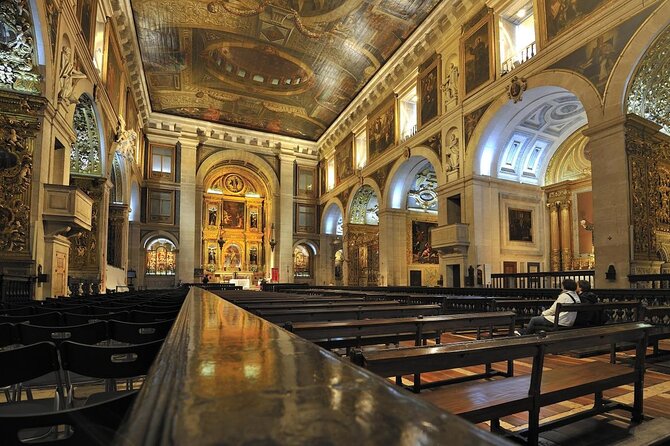
- On-site Portuguese azulejos in churches and historic interiors, so you’re not guessing what you’re looking at
- A route that spans late 1600s to 1900s (and later echoes), letting you compare styles in context
- A small-group feel (max 9), which helps with pace and photo stops
- Stops that mix art + civic life, from a tile-covered brewery to a famous bookstore façade
- Practical Lisbon flavor beyond tiles, including a food moment referenced by many participants
- Clear focus: you learn how to read tiles as Lisbon’s layered story, not decoration only
How tiles turn Lisbon streets into a story you can read
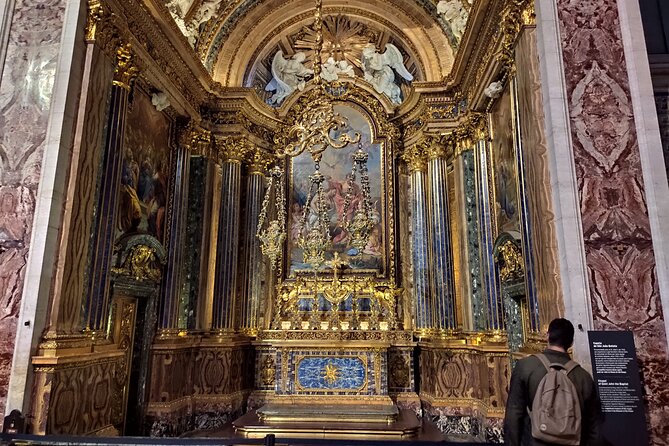
Lisbon has a talent for hiding its history in plain sight. And azulejos are its favorite hiding spot. On this tour, you don’t just point and say pretty. You learn what tilework was used for, how styles changed, and why certain buildings got tiled in the first place.
What makes the tour especially useful is that it teaches you a way of looking. You’ll start noticing things like how colors shift, how patterns change over time, and how Portuguese tile identity emerges from earlier influences. After a few stops, you’ll probably catch yourself staring at walls on your own. That’s the real payoff.
The best moment is when the guide ties tiles to architecture and community—then you see Lisbon as a set of eras stacked on top of each other. The city looks more human when you understand why each surface exists.
You can also read our reviews of more tours and experiences in Lisbon.



Meet the guide who handles rain and pacing well
A big part of this experience is the tour leadership—many people highlight Miguel as warm, attentive, and careful with timing. One common theme in the feedback: he doesn’t rush. If it’s wet, he slows down and thinks about footing. That matters because tile streets and steps can get slick.
You’ll also notice his style is part educator, part local helper. Several reviews mention that he gives extra pointers for the rest of your trip—practical restaurant and neighborhood suggestions, plus transit guidance when needed. If you’re traveling with older family members or you simply tire faster than you used to, that calm pacing becomes a feature, not a problem.
Group size is limited to 9 travelers, which helps a lot. You’re not stuck competing for attention at every corner.
Start in Av. da Liberdade: the launch point for a tile brain-warmup
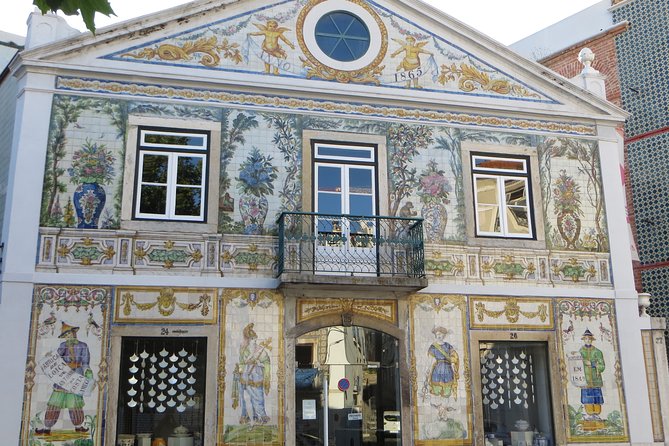
The tour begins at Av. da Liberdade 6, at 10:00 am. This is a convenient starting place because it’s a central address where you can easily line up transit and meet without drama. You’ll get a mobile ticket after booking, and you’re set to go from there.
From the first steps, you’ll be trained to look at “what the tile is doing.” Is it covering a wall for protection? Is it marking prestige? Is it translating a foreign influence into something local? The route is designed so each new stop answers the question from the previous one.
The tour runs for about 3 hours 30 minutes, which is long enough to feel like you learned something real, but not so long that it turns into a full-day grind.
Stop-by-stop: what you’ll see and why it matters
Casa do Alentejo: Moorish mood in a historic house
Your first major stop is Casa do Alentejo. This building is packed with layers: it started as an aristocratic house, then was remodeled in the 19th century, including a time as Lisbon’s first casino. The decoration carries a Moorish influence tied to the romantic style of that era.
Why it’s a strong opener: you get to train your eye on the “feel” of tile aesthetics before you start hunting for specific chronological milestones. You also begin understanding that azulejos weren’t only for churches and courtyards. They were also used to set tone in elite spaces.
If you like interiors and you want more than street façades, this first stop sets expectations in a good way. (And yes, it’s an indoor moment at the beginning, which helps on hot or rainy days.)



Convento de São Pedro de Alcântara: early blue-and-white beginnings
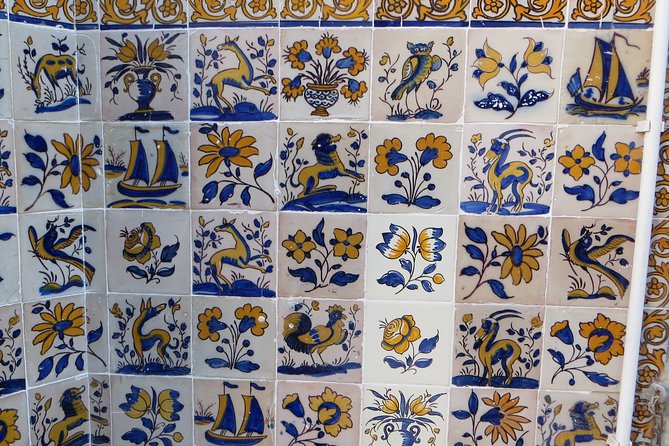
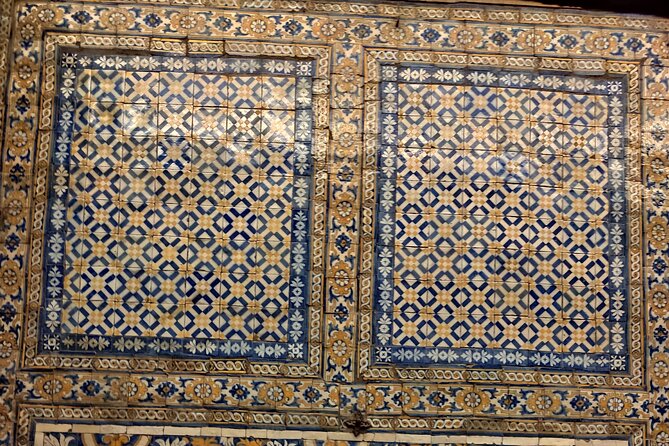
Next comes the church of S. Pedro de Alcântara. Here, you’ll discover some of the beginnings of the blue-and-white tile style in Portugal. The church contains tiles from the end of the 17th century and the beginning of the 18th century.
This stop matters because it gives you a baseline. Once you’ve seen these early blue-and-white examples, later Lisbon tiles start making more sense. The shades, the patterns, and the overall approach feel different than what came afterward.
You’ll also learn how tile style fits religious spaces, which is key in Lisbon. Many cities show history through palaces. Lisbon also shows it through worship spaces and public storytelling.
Igreja de São Roque: signed 16th-century panels in situ
At Igreja de São Roque, you’ll find some of the oldest tile panels in Lisbon in place. These are signed 16th-century panels and mark a shift from Moorish tradition to a more Portuguese brand of tile.
This is a highlight if you care about the “how did it change” question. The guide’s explanation helps you connect influences to outcomes rather than treating Portuguese tiles as a single fixed style. In other words: you don’t just see old tiles; you understand what makes them transitional.
Practical note: churches can mean cooler interiors and sometimes dimmer light, so bring your camera habits accordingly. If you’re sensitive to walking in dark corners, ask the guide for photo angles that don’t require rushing.
Trindade: the oldest brewery under 19th-century tiles
Then it’s off to Trindade, the oldest brewery in town fully covered with 19th-century tiles. This is where azulejos stop being only about religious art and start looking like everyday urban identity.
Why this stop clicks for most people: it changes the category from sacred to civic. You start to see tilework as part of how Lisbon marketed itself, branded spaces, and made daily life look distinctive.
Even if you don’t drink beer, this is a fun visual break because the tile coverage is so complete it becomes architectural.
Largo Rafael Bordalo Pinheiro: a 19th-century façade with Masonic motifs
At Largo Rafael Bordalo Pinheiro, you’ll appreciate a 19th-century tile façade featuring Masonic motifs. You’ll also learn about the man behind this iconic Lisbon façade.
This stop adds a different kind of story: tiles as public symbolism. It’s not only about “who painted it” or “what era it is.” It’s about what messages were meant to be seen on the street.
If you’re the type who loves small background stories (who designed it, who built the identity), you’ll enjoy this one. And even if you’re not, the façade is memorable.
Livraria Bertrand (Chiado): Lisbon’s famous bookstore on blue-and-white display
Next is Livraria Bertrand in Chiado, widely known as one of the oldest bookstores still in operation. The building’s façades are covered with 19th-century blue-and-white tiles.
This is tilework as cultural branding. You’re standing in a place that connects books, commerce, and Lisbon’s public image. After the church and symbolic façade, the bookstore stop shows you a calmer use of tile ornamentation—less about religious messaging, more about prestige and continuity.
If you want a natural pause point for photos and a quick orientation for Chiado, this is it.
Alcôa: a famous pastry spot with a past tied to lottery history
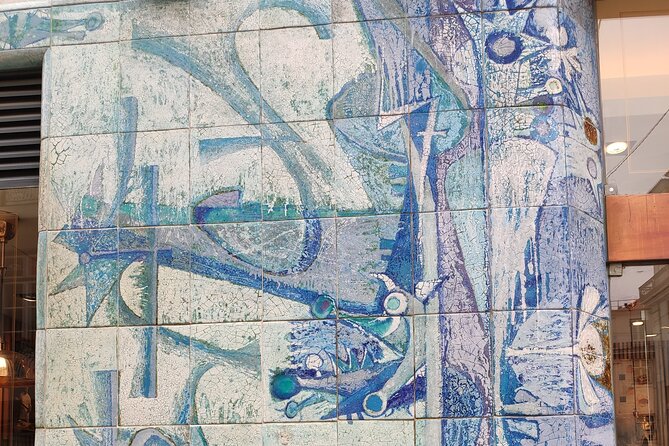
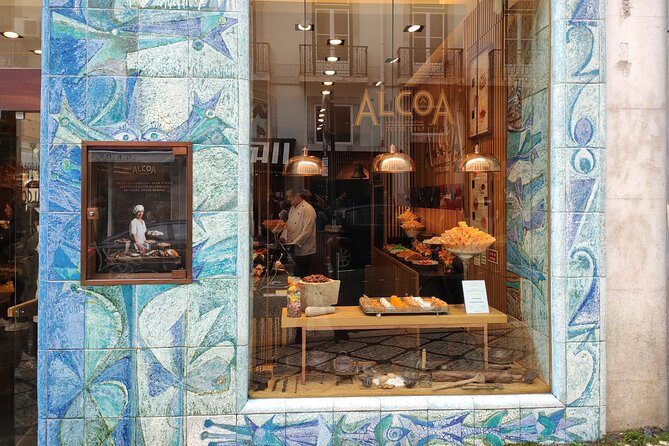
You’ll stop at Alcôa, an iconic Lisbon pastry shop. The twist: it used to be a lottery shop and was covered with ceramic work by one of Portugal’s major 20th-century potters.
Even if you don’t plan to buy anything right away, this stop is useful because it shows azulejos and ceramics crossing into everyday local identity. It’s not frozen in a museum. It lives inside places people actually visit.
This is a good place to take a breath before the walking continues—especially because you’ll hit one of the showroom-style stops afterward.
Praca Dom Pedro IV: tiles meet Lisbon’s main stage
Then comes Praca Dom Pedro IV, one of Lisbon’s most important squares, full of history and stories. It’s not only about tiles here—it’s about context. You’ll connect the tile story to where people gathered, where Lisbon’s public life moved, and why certain buildings mattered.
This stop is also a “reset moment” in the tour rhythm. You get a wider view of the city layout, which helps you remember the route later.
Viuva Lamego: a tile showroom rooted in major factories
At Viuva Lamego, you’ll see where two of Lisbon’s most important tile factories once operated. Today, it functions as a showroom.
This is one of the stops included with admission, and it’s a great way to transition from outdoor spotting to understanding production and design. Seeing tile styles in a dedicated space helps you compare patterns without the visual clutter of streets.
If you’ve been enjoying the tour so far, this stop usually feels like the payoff: it ties the street-level observations into how tiles were made and presented.
Rua da Misericórdia: a store that feels like a tile museum
Finally, you’ll walk Rua da Misericórdia, which is home to a store that’s almost a museum for tiles from many eras. You’ll have time to enjoy tiles spanning different periods, so you can connect earlier lessons to what you see in the shop.
This is a good ending because it gives you control. You can linger with the styles you liked best. If you plan to buy a souvenir, this is where tile-shopping stops being random and starts being informed.
It’s also a practical way to use the last part of your energy: browsing by interest, not just walking to hit the next stop.
The real learning: how Lisbon tile styles connect to power, faith, and change
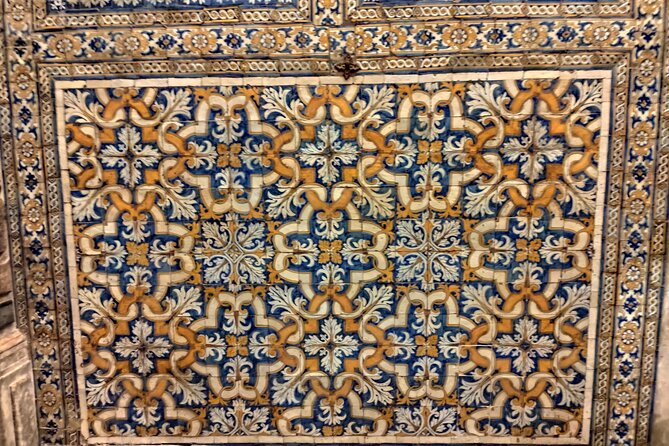
The biggest education goal here is making sense of why tiles look different. You’ll trace shifts from Moorish influence into a Portuguese identity, then forward into later centuries where tiles take on new roles.
A few of the big picture threads you’ll hear about along the way:
- Tiles reflect cultural influence, especially the transition from Moorish tradition to Portuguese style
- Tiles also respond to major historical turning points Lisbon faced over time, including the 1755 earthquake and later political change referenced in the tour context
- By the 19th century, tiles become a tool for public image in places like breweries, bookstores, and squares—not just religious interiors
If you’re the kind of traveler who usually looks at buildings without a timeline, this tour does something valuable. It gives you a timeline you can apply immediately while walking around Lisbon later.
Value check: what you get for $60.24
At $60.24 per person for about 3.5 hours, this doesn’t compete with the cheapest “just walk around” tours. But it also doesn’t feel overpriced when you look at the format: multiple high-value stops with tile panels in situ, a small group size, and a guide who’s focused on both art and city history.
Many stops are set up with free admission tickets, so a chunk of your cost is really paying for interpretation and routing—getting you to the right places and giving you the explanations you’d miss if you walked alone.
Also, you may get a mid-tour food moment. One feedback thread specifically mentions cod cake and a choice around Super Bock (or a non-alcoholic option). You won’t need to guess whether the tour has a human rhythm built in. It tends to.
Net: if you enjoy architecture details and want to leave Lisbon with better “tile literacy,” this price tends to feel fair.
Who should book this tour (and who might prefer something else)
This tour is a great fit if:
- You love tile art, or you want to understand why Lisbon tiles look the way they do
- You’re on your first visit and you want a guided route that teaches visual skills, not just facts
- You prefer a smaller group and a slower pace when needed
You might skip it or pair it with a different tour if:
- You dislike walking or uneven streets and you won’t tolerate that for 3.5 hours
- You want a purely museum-style experience with lots of sitting time (this is mostly walking and outdoor viewing)
After the tour: how to keep spotting tiles without effort
Once the tour ends at a different location, you’re not stuck with knowledge that fades. You’ll likely keep noticing tiles while you do normal Lisbon things—cafés, viewpoints, church exteriors, shop fronts.
My suggestion: take a quick lap around nearby streets right after. Use the comparisons you learned:
- earlier blue-and-white vs later styles
- religious vs civic use
- Moorish influence vs Portuguese identity in pattern and design
You’ll end up feeling like Lisbon is guiding you, not the other way around.
Should you book Portuguese Tiles in Lisbon?
If you want Lisbon to make sense visually, book it. This is one of those experiences where the guide’s explanations change how you read the city for the rest of the trip. With a small group, a comfortable pace, and stops that actually show tilework across eras, it’s a strong way to start your Lisbon days.
Skip it only if you know you won’t handle walking well or if weather is a major risk for your dates—because this experience asks for good conditions and uses adjustments when it’s wet.
Either way, if azulejos are even a little interesting to you, you’ll leave with a sharper eye and fewer “wait, what am I looking at?” moments.
FAQ
What is the duration of the Portuguese Tiles tour?
It lasts about 3 hours 30 minutes.
Where does the tour start?
The meeting point is Av. da Liberdade 6, 1250-144 Lisboa, Portugal.
What time does it start?
The tour start time is 10:00 am.
What language is the tour offered in?
The tour is offered in English.
How large is the group?
The group size is limited to a maximum of 9 travelers.
Is the tour ticket mobile?
Yes, it uses a mobile ticket.
Are there entrance fees at the stops?
The itinerary lists free admission for most stops, and one stop includes admission: Viuva Lamego.
Does the tour require good weather?
Yes. It requires good weather. If it’s canceled due to poor weather, you’ll be offered a different date or a full refund.
Are service animals allowed?
Yes, service animals are allowed.