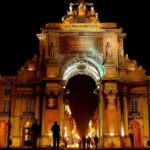
Bairro Alto has stories on every corner. This 2.5-hour walk strings together Rossio Station’s Neo-Manueline drama, Luís de Camões lore, and street-level Lisbon history that you can actually see—then it finishes near a top viewpoint.
I like how the tour gives you two things at once: memorable sights and clear context. I especially love the architecture stop at Rossio Station and the way the guide connects poetry and empire to the squares you pass.
One heads-up: it’s a walking tour with moderate uphill bits, so plan for comfy shoes and a steady pace (you’ll feel it after a couple hours).
In This Review
- Key highlights to pay attention to
- Why this Rossio-to-Bairro Alto route works so well
- Starting at Praça Dom Pedro IV: your Lisbon “map” moment
- Rossio Train Station: a temple façade for trains
- Praça Luís de Camões: how one poet shaped Lisbon’s language
- Bairro Alto’s street layers: plague, walls, and a relic from Venice
- Largo do Carmo and the Carmelite church vow
- Finishing near Miradouro de Santa Catarina: make the view pay off
- Price and value: what $3.61 really buys you (plus the tip)
- Timing, group size, and how to plan your day
- Practical tips so the tour feels effortless
- Should you book this Bairro Alto and viewpoints tour?
- FAQ
- What is the duration of the Lisbon Bairro Alto tour?
- How much does the tour cost?
- What language is the tour offered in?
- Where do I meet and where does the tour end?
- Are there admission fees for the stops?
- What’s included in the tour price?
- Can I cancel and get a full refund?
Key highlights to pay attention to
- Rossio Train Station’s Neo-Manueline façade, including the two intertwined horseshoe portals at the entrance
- Luís de Camões Square and OS Lusiadas, plus the story of Camões losing one eye in Ceuta
- Bairro Alto’s plague-era geography, including where sick people were pushed to live closer to the church
- King Manuel I and a Saint Roque relic from Venice, which ties politics and religion to neighborhood growth
- Largo do Carmo and the Carmelite church vow, funded after Portuguese victory at the Battle of Aljubarrota
Why this Rossio-to-Bairro Alto route works so well
This is the kind of Lisbon walk that helps you get your bearings fast. You start in the grand square at Praça Dom Pedro IV, then move through places that explain how the city’s power, religion, and later rebuilding shaped the streets you’re walking today.
I like that the route feels practical. Instead of jumping all over town, you’re walking a logical line from a major transport hub to Bairro Alto’s older layers, then ending near a viewpoint where the whole area makes sense.
You’ll also feel good about the timing. With an approx. 2 hours 30 minutes duration, you still have plenty of day left to do something else—especially since the tour includes discounts for booking other experiences later.
You can also read our reviews of more tours and experiences in Lisbon.

Starting at Praça Dom Pedro IV: your Lisbon “map” moment
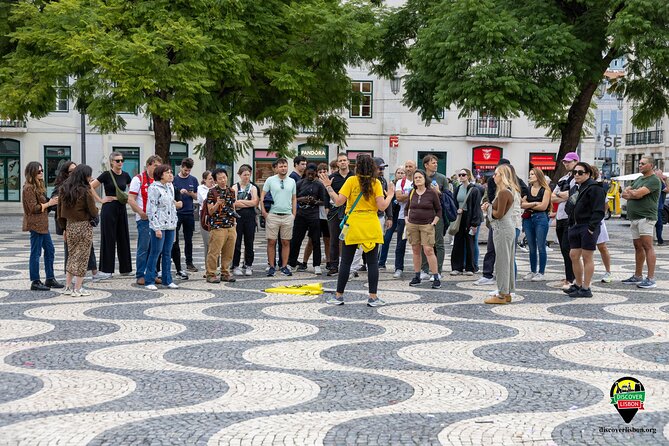
You meet at Praça Dom Pedro IV, the kind of starting point where Lisbon instantly shows you its character. It’s a big crossroads square, so it’s easy to orient yourself even before the history talk starts.
From here, you’ll walk through key areas that lead you toward Bairro Alto. That “getting there” part matters. If you’ve only seen Lisbon from photos, this first stretch helps you understand the city’s slope, street width changes, and the way neighborhoods stack on top of each other.
Also, many stops along the way are ticket-free, so you’re not constantly breaking rhythm to pay or queue.
Rossio Train Station: a temple façade for trains
Stop two is Estação do Rossio, and it’s one of those places that makes you stop mid-step. The station was commissioned by the Portuguese Royal Railway Company and designed between 1886 and 1887 by architect José Luís Monteiro. It was completed in 1890 and built right in one of Lisbon’s most important squares.
What you’re really looking at is Neo-Manueline architecture. Think of it as a Romantic recreation of the exuberant Manueline style from early 16th-century Portugal. The outside façade doesn’t just look ornate—it looks like it belongs in a story about empire and grandeur.
Here are the specific details to watch for:
- The entrance has two intertwined horseshoe portals
- The portals say Central Station
- The façade can feel more like a temple than a train station
And there’s a practical angle, too. The station historically connected Lisbon to the region of Sintra, so it wasn’t only about moving people around the city. It mattered for travel beyond Lisbon, which helps you understand why Lisbon’s transport and tourism grew so strongly over time.
Praça Luís de Camões: how one poet shaped Lisbon’s language
Next you reach Praça Luís de Camões, named for Portugal’s national poet. This is where the tour turns a street corner into a story you can carry with you.
Camões wrote OS LUSIADAS, the epic poem about Vasco da Gama’s sea route to India. That might sound far removed from a neighborhood walk, but the point is how ideas travel the same way ships did—through language, education, and identity.
One of the most memorable facts you’ll hear is that Camões is said to have lost one eye in a battle in Ceuta. When you remember that, the statue and the square feel less like decoration and more like a reminder that big literature often comes from a hard life.
The guide also connects Camões’s influence to everyday Portuguese culture. You’ll learn why Portuguese is sometimes called the language of Camões. Even if you’re not a poetry person, it’s a neat way to understand why the city names so many places after writers, not only kings and battles.
Bairro Alto’s street layers: plague, walls, and a relic from Venice
Now you’re in Bairro Alto, and this is where the tour’s history becomes “real-life geography.” The area’s story links a few big themes: Lisbon’s growth after the Age of Discoveries, defensive walls, and the way disease and religion reshaped where people lived.
Here’s the shape of the explanation you’ll get:
- In the late 15th century, Lisbon swelled with people from around the world after discovery-era changes
- The city center needed expansion, and the place around today’s Camões square used to function as an entrance to the city
- Earlier defenses like the Fernandine wall and the Door of Santa Catarina mattered here, and after later destruction, what you see today reflects those shifts
You’ll also hear about the earthquake and the wreck-and-rebuild pattern that changed Lisbon’s map. After the major destruction, two churches—Encarnação and Loreto—ended up in the area linked to the earlier defensive layout. That’s a useful lesson: Lisbon isn’t just old. It’s old plus repeatedly rebuilt.
Then the tour moves into the darker, more human side of the neighborhood:
- On one side of the wall were areas tied to wealthy noble families
- On higher ground there was a cemetery of victims of the black plague
- In 1506, King Manuel I asked for a relic of Saint Roque from Venice and placed it in a hermitage near that area
As the population rose and the black plague hit, the less fortunate and sick ended up moving closer to the church. An urban plan developed to deal with this reality, and you can see how the neighborhood became what it became.
If you like walking tours that explain why a place looks the way it does, this part will click. You stop thinking only about views and start noticing slope, street placement, and how institutions influence real estate—even when the institutions are religious and the context is tragic.



Largo do Carmo and the Carmelite church vow
The next stop is Largo do Carmo, tied to the Carmelite church and convent. You’ll hear that the church was built in 1389 after Nuno Álvares Pereira—a military leader who helped King John repel Castilian troops—vowed to build what he called the world’s most beautiful church if he won at the Battle of Aljubarrota in 1385.
Portuguese victory followed. Pereira kept his word and funded the Carmelite church and convent. After the completion in 1423, he joined the Carmelite order and spent the rest of his life in the convent.
This stop matters for two reasons. First, it shows how Lisbon’s religious architecture is often connected to power struggles and promises made in wartime. Second, it’s a reminder that people weren’t always building “for tourism.” They were building for devotion, identity, and legacy—then history did the rest.
You’ll likely move through the area at a calmer pace here. It’s a good moment to look up and notice details in stone and structure, because this complex is tied to centuries, not just a single era.
Finishing near Miradouro de Santa Catarina: make the view pay off
Even though Largo do Carmo is a key historical stop, your tour wrap-up points you toward Miradouro de Santa Catarina for final viewpoint time. That end location is smart. You get the neighborhood context first, then you see how Bairro Alto sits in Lisbon’s hills.
A good viewpoint walk isn’t just about photos. It’s about comprehension. From above, you can start to match what you learned—walls, rebuilding, and neighborhood functions—to the actual slope and street grid.
If you’re planning a later evening, this is also a handy finish point. You’ll be close to where people naturally linger after sunset, so you can pivot into dinner or a short wander without needing transportation for every step.
Price and value: what $3.61 really buys you (plus the tip)
Let’s talk money, because the price looks almost too low to take seriously. The tour costs $3.61 per person, lasts about 2 hours 30 minutes, and includes a local expert guide plus cultural and historical explanation.
Here’s where the real value shows up:
- Many stops are free to view or access on your route
- You get guided interpretation of big themes—especially Lisbon’s earthquake and past destruction
- There are fun facts and monument context, not only dates
- There’s a specific benefit for later plans: discounts for booking other experiences the rest of the day and night
One caution on budgeting: there’s an optional contribution to the guide listed as 10–20€. That doesn’t mean you’re forced to pay it, but it’s smart to treat it as part of the real cost if you want to support the person doing the explaining.
Also, the tour notes what’s not included. Santa Justa elevator entry isn’t part of this experience, and private transportation isn’t included. If you’re thinking about Santa Justa later, you’ll need to plan that separately.
Timing, group size, and how to plan your day
This is English offered, with mobile tickets, and it’s typically booked about 5 days in advance on average. That’s a sign the walk is popular, even though it’s short.
The group size max is 50 travelers, so it’s not a tiny private chat. Still, it’s small enough that the guide can keep everyone together and explain on the move.
Because you’re covering multiple central points—Rossio, Camões Square, Bairro Alto, and Carmo—you’ll want to plan around your energy level. The tour requests a moderate physical fitness level, which usually means you’re okay with walking and some ups and downs.
If you’re doing another big sight the same day, aim for breaks afterward. This tour gives you plenty of walking and talking, so you’ll enjoy a slower second half of the day.
Practical tips so the tour feels effortless
I’d pack like you’re touring a hilly neighborhood, not like you’re going to a flat museum. Wear shoes that grip. If you’re sensitive to steep streets, take your time at the slower corners.
A few other practical moves:
- Bring your mobile ticket and keep it easy to access
- The tour is near public transportation, so you can usually adapt if your first stop doesn’t start exactly how you expected
- If you like to absorb details, keep your phone handy for photos of façades and squares, but listen first—this route rewards attention to small architectural clues
Since you end near Miradouro de Santa Catarina, I’d also have water ready. Viewpoints can trick you into thinking you’ll be done soon, but that last bit often becomes your longest linger.
If you want a smooth day plan, look at the built-in idea: use the discounts from this experience to line up one more activity later. It’s a nice way to avoid last-minute guesswork when you’re tired.
Should you book this Bairro Alto and viewpoints tour?
Book it if you want Lisbon history explained where it happened, with stops you can actually point to. This is a strong choice for your first or second day in Lisbon because it teaches you the neighborhood logic: Rossio’s role, Camões’s cultural weight, Bairro Alto’s plague and rebuilding story, and the Carmo complex tied to a vow.
You might skip it if you hate walking tours or you need a very relaxed pace. With 2.5 hours and hills involved, this is best for people who can enjoy a steady stroll and a guide-led rhythm.
If you do book, set a simple goal: notice one architectural detail at Rossio, one poetic detail at Camões Square, and one street-level clue in Bairro Alto. You’ll finish with a viewpoint—and you’ll finally understand what you’re looking at.
FAQ
What is the duration of the Lisbon Bairro Alto tour?
It runs for about 2 hours 30 minutes.
How much does the tour cost?
The price is $3.61 per person.
What language is the tour offered in?
The tour is offered in English.
Where do I meet and where does the tour end?
You start at Praça Dom Pedro IV, 1100-581 Lisboa, Portugal, and end at Miradouro de Santa Catarina, 1200-262 Lisboa, Portugal.
Are there admission fees for the stops?
The stops listed on the route show admission ticket free. Santa Justa elevator entry is not included.
What’s included in the tour price?
Included items are a local expert and dedicated guide, insights into Portugal’s culture and history, history about Lisbon’s earthquake and past destructions, discounts for booking other experiences in Lisbon, and history of famous monuments and fun facts.
Can I cancel and get a full refund?
Yes. You can cancel for a full refund if you cancel at least 24 hours before the experience starts.